Why Most GenAI Pilots Fail to Drive Revenue—and How to Fix It

The Hidden Patterns Behind Successful AI Transformations

APRIL 2026 EDITION

By now, the pattern is almost boring. A company greenlights a generative AI pilot, demos a slick assistant in a town hall, gets a few headlines internally, then watches the thing fade into a corner of the org chart. TechBrew's coverage of McKinsey's 2025 findings put numbers on what operators already felt in their bones: plenty of pilots, very little money. That's the real story—not whether GenAI can write a paragraph or summarize a meeting, but why all that activity so rarely lands on the income statement.

McKinsey found that 65% of enterprises had launched GenAI initiatives by early 2025, yet only 17% saw revenue growth above 5%. Gartner nudged adoption even higher by late 2025, to 72%, while revenue-positive pilots barely cracked 19%. BCG says 85% are still stuck in proof-of-concept limbo. At the same time, companies are spending real money—IDC put global GenAI spend at $214 billion in 2025. So no, the issue isn't lack of enthusiasm. It's that most pilots are built like science projects when they should be built like revenue systems.

"Pretty output isn't the same as commercial lift. If the workflow doesn't change, the revenue won't either."

The Real Reason GenAI Pilots Stall Before Revenue

The first mistake is obvious once you see it: teams start with the model instead of the commercial bottleneck. They ask what the tool can do, not where margin is leaking, where sales cycles drag, where service teams miss upsell signals, or where pricing decisions get made with lousy information. Lareina Yee at McKinsey said most pilots fail because they're tech experiments, not business transformations. She's right. A smart demo isn't a growth strategy. It's a demo.

The second problem is fuzzier, and more dangerous. Companies choose vague use cases with no single owner. Someone in innovation sponsors it, IT provisions access, a business unit sits in a workshop, and everybody says the project matters. But who owns the revenue line? Who loses sleep if conversion stays flat? Too often, nobody. So the KPI deck fills up with soft measures—time saved, prompts used, employee sentiment—while pipeline velocity, gross margin, retention, average order value, and win rate sit untouched.

The Data Quality Problem

Andrew Ng's old warning still bites: garbage in, garbage out. BCG says 42% of stalled pilots trace back to poor data quality. A model can sound brilliant and still fail because it can't reliably pull product data from an ERP, customer history from a CRM, or policy rules from a knowledge base.

Then there is the plumbing. A model can sound brilliant and still fail because it can't reliably pull product data from an ERP, customer history from a CRM, or policy rules from a knowledge base. That's why retrieval-augmented generation, strong metadata, and clean API layers matter more than another prompt library. Messy source systems turn GenAI into an expensive guessing machine.

And then comes the human layer. Talent shortages matter, yes, but the deeper issue is operating discipline. Most organizations still staff pilots with a thin innovation squad and hope the business will absorb the outcome later. It won't. Frontline managers need to redesign workflows, finance needs to validate the business case, legal needs guardrails, and product teams need evaluation routines that go beyond vibes. Deloitte's 2026 report said 78% of AI pilots were abandoned within 12 months.

Business team redesigning workflow ownership and process before AI deployment, showing digital marketing automation and content strategy planning

Fix the Operating Model Before the Prompt

The companies that win don't start with a model. They start with a bottleneck tied to the P&L. That could be contract review time in a legal-heavy sales motion, demand forecasting in a margin-sensitive supply chain, lead qualification in a bloated funnel, or renewal risk in a subscription business. The best pilots are narrow enough to measure and important enough to matter. One workflow. One economic outcome. One accountable owner.

Before a single vendor gets invited in, the team should know the baseline, the target lift, the payback window, and the kill criteria. Brutal clarity helps.

"The best pilots are narrow enough to measure and important enough to matter."

Next, build what JPMorgan effectively built: cross-functional AI pods. The bank ran more than 400 GenAI pilots in 2025, but only the ones with serious business ownership scaled. Its contract-analysis work didn't succeed because lawyers suddenly loved prompts. It succeeded because product, data, ops, risk, and the business were in the room from day one, working against a concrete value case. The result was roughly $100 million in annual savings and about 15% efficiency gains in legal operations.

The stack matters too, just not in the way vendors pitch it. Production systems need evaluation harnesses, fallback logic, permissioning, audit trails, and data retrieval that actually respects context. In many cases, open models are becoming the practical choice because teams can tune them, control costs, and keep sensitive workflows closer to home; Hugging Face reported Llama-based pilots were twice as likely to scale in early 2026.

Measure Like Finance, Not Like a Lab

Then measure like finance, not like a lab. Satya Nadella said too many Copilot pilots gather dust because business KPIs weren't defined on day one. Exactly. Revenue-first teams track influenced pipeline, conversion rate, attach rate, discount leakage, churn reduction, service-to-sales handoff, and gross profit per labor hour. They run control groups when they can. They compare AI-assisted work against a baseline. They also shut weak pilots down quickly.

Success Story: Siemens

Siemens did this well with its pilot-to-production framework and turned GenAI in industrial design and predictive maintenance into roughly €200 million in revenue. P&G had to learn the hard way, after early pilots fizzled, before rebuilding around ROI tracking. Painful. Effective.

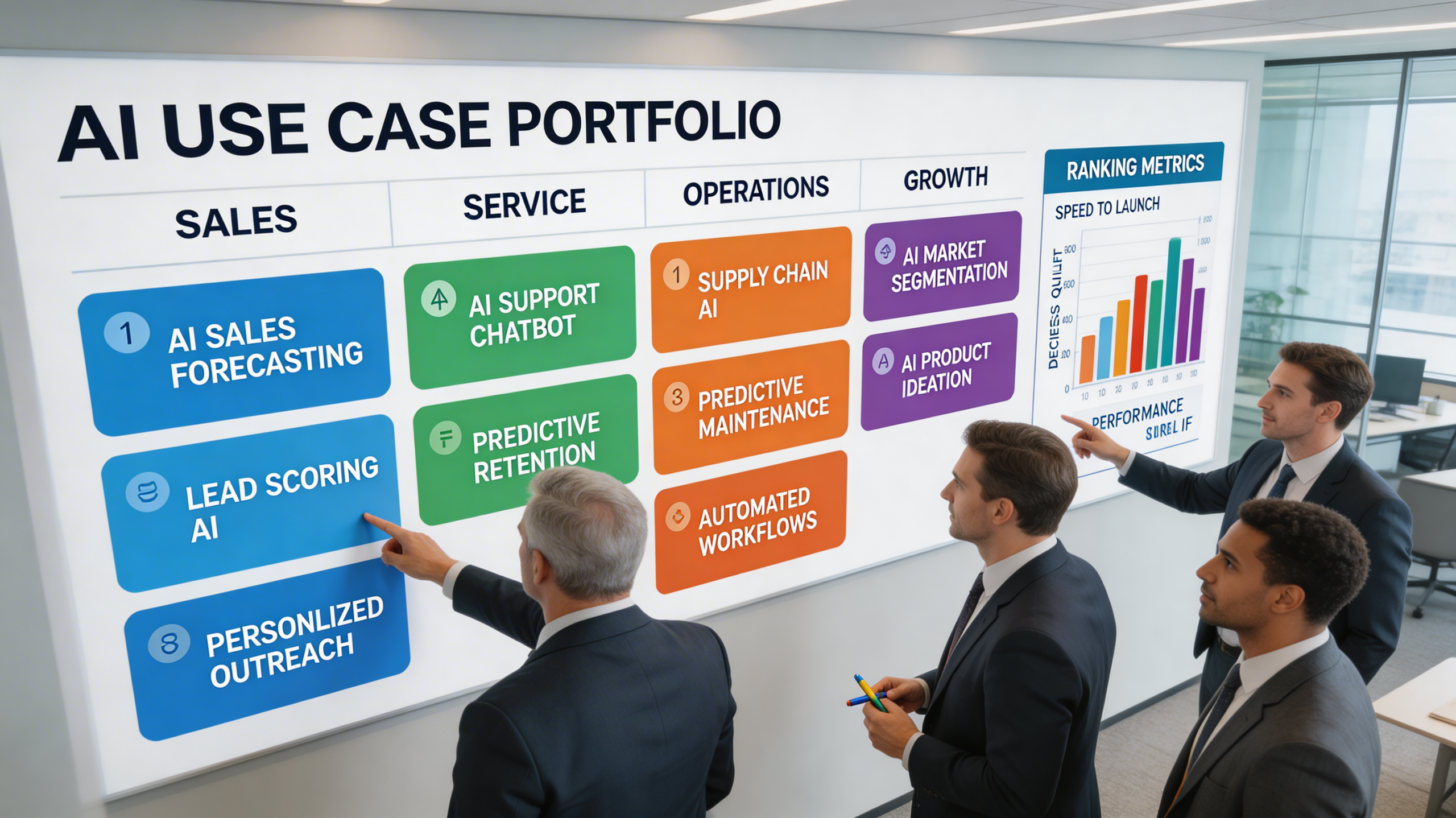
Executives prioritizing a portfolio of scalable AI revenue use cases, highlighting content strategy and marketing automation for business growth

Where Marketing Automation Actually Creates Revenue

Marketing is where GenAI gets both overhyped and underused. Overhyped because companies adore fast copy generation and confuse speed with growth. Underused because the real money isn't in having the model write ten more subject lines. It's in connecting customer signals, campaign logic, creative variation, merchandising decisions, and sales follow-up so the right offer reaches the right buyer at the right time.

P&G's turnaround is the clean example. Its early pilots reportedly saw about 80% abandonment because the data lived in silos and nobody could connect model output to business performance. The later fix was much sharper: integrate LLM-driven decisioning with supply chain and customer data, then hold teams to revenue metrics. That shift helped generate about $50 million in marketing personalization revenue.

"Use AI to connect web behavior, email engagement, call notes, and CRM changes so follow-up happens when buying intent is warm."

For teams building demand engines, the sweet spot is orchestration. Use blog automation to speed research, outlines, refreshes, and internal linking—but only when it plugs into a real content strategy built around search intent, product proof, and conversion paths. Use AI in social media marketing to test hooks, summarize audience feedback, and triage community questions—but don't let it turn every post into the same bland slurry.

10 Hot AI Plays Worth Scaling Right Now

If you want GenAI to earn its keep, stop hunting for one giant moonshot. Build a portfolio of revenue-linked use cases across operations, sales, service, and growth. The hottest bets in 2026 aren't random toys; they're workflows where better decisions happen faster, with cleaner context and lower labor drag.

The Short List

  1. AI sales copilots inside the CRM that surface next-best actions, draft account briefs, and flag stalled deals before the quarter slips away.
  2. Agentic customer service flows that resolve simple issues automatically, then tee up cross-sell or renewal opportunities for a human rep.
  3. Dynamic pricing and promotion engines that respond to demand, competitor behavior, and inventory constraints in near real time.
  4. Contract review and revenue leakage detection for sales, procurement, and legal teams drowning in clauses, exceptions, and missed renewals.
  5. Demand forecasting linked to inventory allocation so product availability supports revenue instead of sabotaging it.
  6. Procurement and supplier negotiation agents that identify cost anomalies, shorten cycle times, and protect gross margin.
  7. Creative testing at scale for paid media, landing pages, and lifecycle campaigns, with guardrails against brand drift and compliance issues.
  8. Voice-of-customer mining across calls, chats, reviews, and support tickets to expose churn drivers and hidden upsell signals.
  9. Knowledge copilots for field teams, account managers, and service staff who need instant answers pulled from manuals, policies, and customer history.
  10. RAG and synthetic-data programs for high-value domains where privacy, sparse data, or regulated content would otherwise block deployment.

Notice what these have in common. They sit inside real workflows, they rely on proprietary context, and they connect to cash. Some grow top-line revenue directly. Some protect margin. Some do both. That's why the old vanity metrics have to go. Measure marginal revenue lift, CAC payback, conversion to qualified opportunity, average handling time with quality controls, renewal probability, and gross margin improvement.

The message from McKinsey, and from the ugly pile of abandoned pilots behind it, is straightforward: GenAI doesn't fail because businesses lack imagination. It fails because they confuse experimentation with execution. The winners treat AI as a profit center, wire it into the bloodstream of the business, and insist on commercial proof early. That can happen in a global bank, a manufacturer, or any company. Same rule everywhere. Find the bottleneck. Attach a number to it. Build the workflow. Then let the model earn its seat.