The New Playbook for AI Pricing, Promotions, and Margin Optimization

How AI-powered pricing systems are delivering 3.1% margin gains and transforming revenue operations

APRIL 2026 EDITION

The Old Pricing World is Over

Pricing used to sit in a spreadsheet, promotions lived in a calendar, and margin management got dragged into the room after the damage was already done. That world is over. Volatile input costs, twitchy demand, channel fragmentation, and customers who can compare offers in seconds have turned price into a live operating system, not a quarterly debate.

McKinsey's playbook matters because it treats AI less like a dashboard and more like a revenue operator. The headline numbers are hard to ignore: companies using agent-led pricing and promotion systems are seeing average gross-margin gains around 3.1%, with EBITDA improvement in the 2% to 5% range inside 12 to 18 months. Gartner now says 68% of Fortune 500 companies use AI for dynamic pricing. In a market where growth is expensive, that kind of lift changes boardroom behavior fast.

"Price should react to reality, not to the meeting schedule"

The Playbook Changed Because the Market Did

The old model broke for a simple reason: it assumed conditions stayed still long enough for humans to catch up. They don't. Cost-to-serve changes by customer. Competitors move at noon. Inventory risk shifts by region. A promotion that looked sensible on Monday can be margin vandalism by Friday, especially when cross-price elasticity, basket mix, cannibalization, and trade-spend all collide at once.

That's why the best operators are no longer asking AI for a single answer. They're using it to simulate thousands of scenarios, rank them by profit impact, and learn from the result. BCG has described the new generation of pricing agents as capable of testing more than 1,000 scenarios a minute; humans simply can't work at that speed. And speed matters because pricing isn't one decision anymore. It's a chain of micro-decisions.
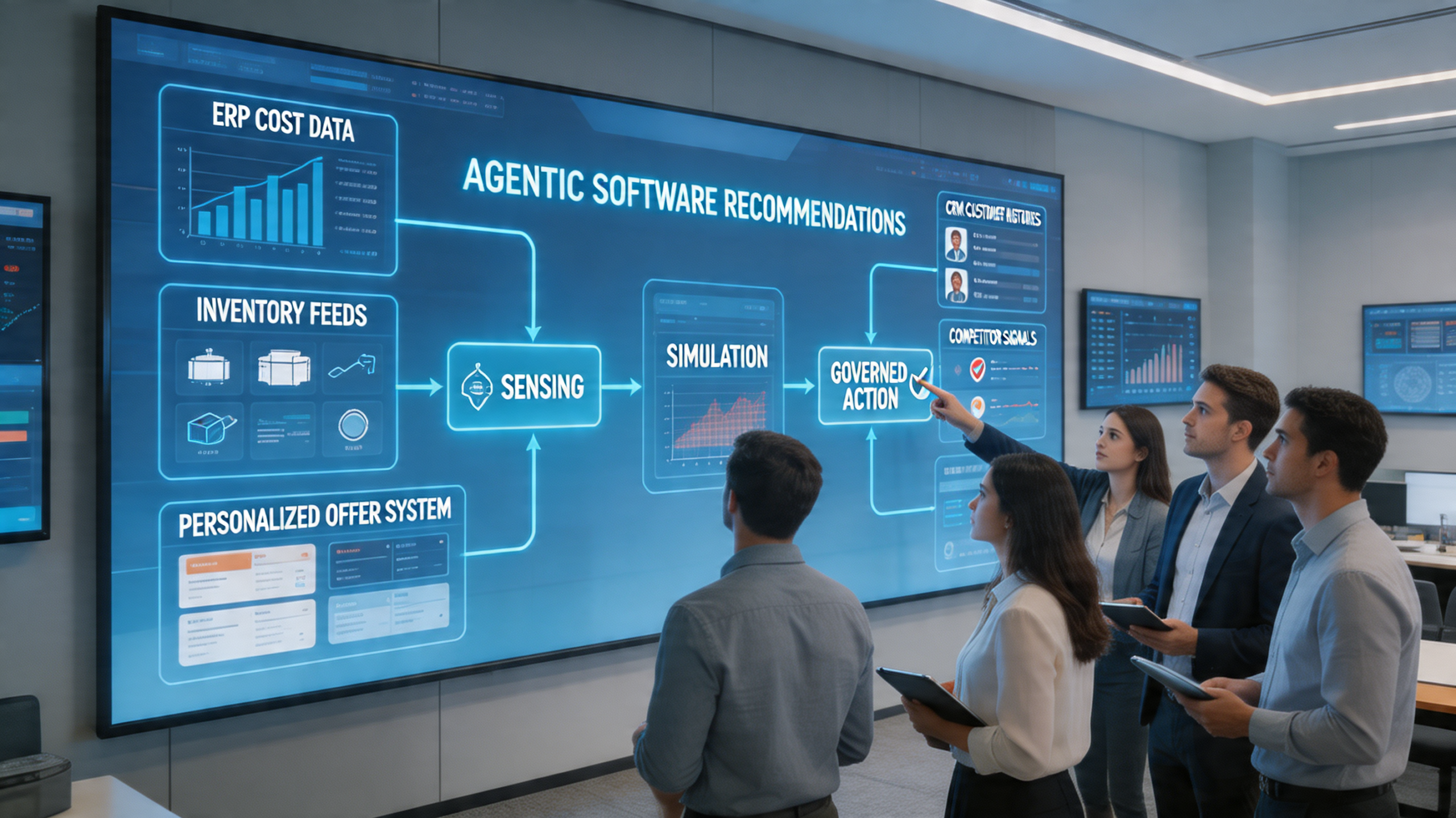

Corporate technology team connecting pricing tools with customer and inventory systems, showing marketing automation and content marketing workflows

AI Agents Transform Commercial Operations

McKinsey's real contribution is the shift from predictive models to agentic systems. A model forecasts demand. An agent notices a freight-cost jump on a top-selling SKU, checks inventory cover, compares local competitor moves, recommends a narrower discount, and routes the action to the right owner—or acts within guardrails. That's a different machine altogether. It thinks in workflows, not just scores.

Still, the story isn't just math. Between EU AI Act enforcement and the FTC's 2025 pricing guidance, governance has moved from legal footnote to design principle. Fairness audits, price floors and ceilings, human review for sensitive segments, and anti-collusion controls aren't optional extras. After the pricing blowups of 2025, smart companies learned the hard way: over-optimization can burn trust faster than it lifts margin.

The New Pricing Stack

The real leap is agentic: software that senses, decides, simulates, and, in tightly governed settings, acts. In practice, that means connecting the pricing engine to ERP cost data, CRM histories, inventory feeds, competitive signals, and the offer systems that actually touch the customer.

Operating Model Evolution

The operating model matters as much as the math. Companies getting payback in roughly six months usually start in shadow mode, where the agent makes recommendations while humans compare outcomes against the old process. Then they add controls: override thresholds, approval bands for strategic accounts, margin floors by channel, and exception queues for anything that could create legal or reputational heat.

Retailers are pushing these systems into markdown cadence, bundle design, and store-level assortments. CPG firms use them to curb discount leakage and clean up trade promotion management. Travel brands fold them into yield decisions, local events, and weather swings. SaaS teams are using AI to tune packaging, contract renewals, and expansion offers.

"Over-optimization can burn trust faster than it lifts margin"

Best-Practice Guardrails

  1. Run the agent in shadow mode before letting it execute anything customer-facing
  2. Set hard floors, ceilings, and approval bands by segment and channel
  3. Log every recommendation, override, and reason code for auditability
  4. Review fairness and discrimination risk on a fixed cadence, not after a complaint
  5. Tie incentives to incremental margin, not raw volume

Promotions and Margin Optimization in Practice

Where Margin Quietly Bleeds Out

Promotions are where margin quietly bleeds out. They look like revenue engines on the top line and then you inspect the mechanics: deep discounts on customers who would've bought anyway, broad coupons that train shoppers to wait, bundles that lift unit volume but weaken mix. Deloitte's range is sobering—AI-driven promotion programs can cut waste by 25% to 40%, and personalized offers convert about 2.5 times better than the old broadcast approach.

Real-World Results

P&G used AI-driven pricing and promotion logic across more than 5,000 SKUs and reported 4.2% margin expansion plus roughly $800 million in annual savings. Walmart tied personalized promotions to supply-chain signals across 4,499 U.S. stores and lifted basket size by 12% while improving margins 2.8%.

The companies winning on margin aren't discounting less; they're discounting with far more precision. Here's the part too many teams miss: pricing isn't only a numbers problem. It's a message problem too. A sharp bundle, a gated offer, or a smaller-but-smarter discount only works if the customer sees the value instantly.

Ten Hot AI Revenue Plays to Test Now

  1. Dynamic price corridors by SKU and customer. Agents adjust within approved bands using elasticity, competitor signals, inventory exposure, and service cost.
  2. Promotion copilots that rewrite calendars weekly. Uplift models can kill low-yield discounts before they hit the market.
  3. Trade-spend optimization for CPG and distributors. AI allocates discounts and co-op dollars where incremental volume actually covers the margin give-up.
  4. Quote and negotiation agents for B2B sales. Recommend walk-away price, likely win rate, payment terms, and cross-sell options.
  5. Inventory-linked markdowns. Smaller markdowns triggered earlier on aging stock usually beat dramatic end-of-season fire sales.
  6. Personalized bundles and next-best-offer design. Target conversion, attach rate, basket size, and healthier product mix.
  7. Churn-save pricing for subscriptions. Estimate save elasticity before renewal and tailor retention offers by customer lifetime value.
  8. Edge and local pricing. Combine store traffic, weather, events, labor availability, and nearby competitor data.
  9. SEO optimization for price-intent pages. Use AI to detect the queries closest to purchase, then align landing-page offers.
  10. Multimodal shelf and sentiment sensing. Vision models, receipt data, and social chatter reveal when promotions fail in practice.
"The businesses that master it won't merely price better. They'll learn faster than the market around them."

The rollout sequence matters more than the vendor pitch. Start with one margin pool, one decision loop, and one clean success metric—realized price, incremental gross margin, discount leakage, or promo ROI. Prove lift in a category or segment. Then wire the agent into adjacent decisions such as demand forecasting, replenishment, campaign timing, and sales execution.

For leaders at companies like Joe's Site, the opportunity is bigger than trimming a few points off discounting. This playbook turns AI into a commercial operating layer that sees faster, reacts earlier, and protects profit while it grows revenue. The businesses that master it won't merely price better. They'll learn faster than the market around them. That tends to show up on the income statement.