The Email Conversion Playbook

How AI Agents and Modern Tactics Turn Leads into Clients

PREMIUM EDITION 2025

Email marketing still prints money. The Data & Marketing Association pegs the channel at roughly $42 in revenue for every $1 invested, and that's not a vanity stat. It's a reminder that when your message lands with intent and timing, it converts. The problem today isn't whether email works; it's whether your program cuts through an inbox drowning in sameness.

Regulation, inbox algorithms, and smarter buyers have raised the bar. Batch-and-blast died years ago; hyper-personalization, behavioral triggers, and transparent data practices now separate the winners. Meanwhile, mobile rules the open—north of 60% of emails are read on phones—so every pixel is working under time pressure and thumbs.

"The modern playbook blends disciplined craftsmanship with machine precision."

The modern playbook blends disciplined craftsmanship with machine precision. Think AI Agents orchestrating workflows, AI automation optimizing decisions at the speed of a click, and creative that speaks like a human, not a robot. Teams using ezwai.com are treating these systems like capable AI employees embedded across the lifecycle, not just shiny tools. That shift—from tools to teammates—changes everything about outcomes.
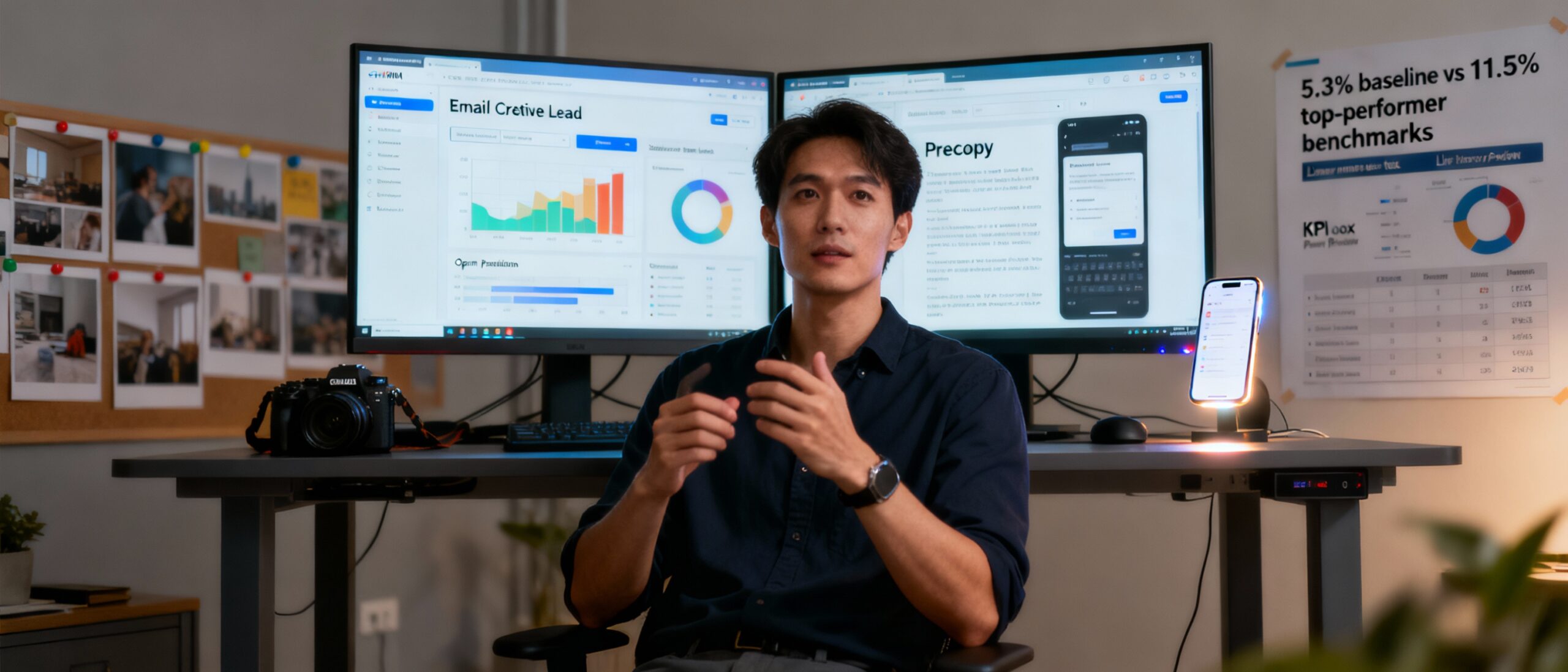
AI Agents and Automation

At high-performing companies, AI Agents sit across the funnel: list hygiene, segmentation, send-time optimization, subject line testing, and even content assembly. They don't replace marketers; they extend them. The smartest orgs define roles, guardrails, and handoffs—just as they would with new staff—so AI employees know what "good" looks like and when to escalate.

If you still blast the same email to everyone, you're paying to be invisible. Precision starts with durable, consented data: first-party behavioral signals, product usage, and lifecycle milestones. Feed that into models that cluster by intent and value, not just demographic lookalikes. Then let automation schedule and enrich sequences per audience, not per calendar.

AI Timing Optimization

Timing is math. AI looks at open and click histories, device patterns, and seasonal cycles to send each message when a person is most likely to engage. Multiply that across thousands of leads and you unlock conversion deltas that human schedulers simply can't touch.

Creative matters just as much. AI-assisted copy and design can accelerate production, but the point isn't volume—it's relevance. Pull in dynamic blocks: pricing tiers for prospects, how-to content for new customers, and customer stories for buyers on the fence. Marry this with AI Content Marketing pipelines so email is fed by a living library of assets that answer questions your market actually asks.

Segmentation, Prediction, and Timing

Segmentation used to mean industries or job titles. Now it's intent density: what someone read, downloaded, and did in product, stitched into a rolling propensity score. Prediction then informs cadence—how many touches, in what order, with which message—and the optimal send time per person.

When this engine hums, you'll watch conversion curves bend. Campaign Monitor's 2025 benchmarks show average conversion around 5.3%, with elite programs nudging past 11%. That gap is segmentation and timing discipline, full stop. AI automation just makes it repeatable at scale.

  • Cluster by intent, recency, and value—not just firmographics.
  • Use send-time optimization at the contact level, not just time zones.
  • Throttle frequency dynamically to protect sender reputation.
  • Map creative variants to segment hypotheses you can prove or disprove.
AI automation in email marketing

Creative at Scale, Not Spam at Scale

AI tools can churn out passable copy all day. Resist that. The teams that win set brand voice rules, examples, and negative instructions inside their workflows so AI doesn't slip into generic sludge. They also pair machine-generated drafts with editor judgment—because craft is still competitive advantage.

Dynamic content blocks deserve a strategy. Use product usage, ticket history, and content consumption to swap in the right assets: onboarding guides, ROI calculators, case studies, or a human "can I help?" note. Let an AI Agent score the next best content, then log whether the choice was clicked to train subsequent selections.

"Your sender name, preheader, and subject line should sound like a person you'd reply to."

Finally, remember the human inbox. Your sender name, preheader, and subject line should sound like a person you'd reply to. You're asking for attention, not a transaction—at least not until trust is earned.

From SEO-AEO to Inbox: Building a Demand Engine

Search powers demand, and email harvests it. That loop tightens as SEO and AEO (Answer Engine Optimization) converge. People don't just "Google and click" anymore; they ask AI systems questions and expect concise, credible answers. Your AI Content Marketing has to structure those answers so they rank in search results and surface inside answer engines—and then repurpose cleanly into email.

Think of your site as an answer graph: schema markup, clear headings, and authoritative copy supported by proof. Those same components become modular email assets—snippets for nurture, deeper dives for onboarding, and buyer stories for late-stage friction. The content supply chain matters as much as the content itself.

Teams building with AI employees to manage this pipeline gain speed without losing control. An AI Agent drafts outlines from search intents, another surfaces citations, and a human editor tightens the story. Next, a trigger in your CRM launches a sequence: the researcher gets a guide, the evaluator a comparison, the champion an ROI calculator. Orchestrated, not improvised.

Design for Conversion

Open rates are a vanity metric until they aren't. Strong sender names, punchy preheaders, and curiosity-led subjects still matter because they create the conditions for conversion. Across industries, email conversion averages 5.3% with top performers cresting 11.5%. The delta isn't luck; it's surgical targeting, strong offers, and friction-free UX from inbox to landing page.

Personalization works when it's useful. Epsilon found 80% of buyers are more likely to purchase when the experience feels tailored. That doesn't mean first-name gimmicks; it means content that reflects what someone is actually trying to accomplish. Replace "just checking in" with a product shortcut or a relevant win story from a similar customer.

Interactive Elements Drive Results

Experian's research shows interactive elements can lift click-through rates by roughly 73%. Polls that inform the next email, lightweight calculators, even a two-button "what do you want to see next?" micro-choice—all of it helps the subscriber co-author the journey.

Mobile dominates reading behavior, with Litmus reporting around 61% of opens on phones. Design like you've only got 30 seconds and a thumb: large tap targets, fast-loading layouts, and short copy blocks with a clear, single CTA per screen. Accessibility isn't a nice-to-have; it's table stakes for reach and brand equity.

Personalization That Feels Human

Start with a real use case. If someone downloaded your onboarding checklist, send a plainspoken email from a named human offering a 10-minute setup assist. If they watched a pricing video and stalled out, follow with a value calculator and two customer quotes from their industry. Your marketing should feel like help, not a parade of offers.

  • Trigger on behavior, not calendar dates.
  • Use dynamic blocks to swap assets by lifecycle stage.
  • Avoid empty personalization; tie every variable to utility.
  • Favor short, scannable copy with one clear action.

Mobile and Accessibility First

Design for dark mode, large text, and high-contrast buttons. Keep images lightweight and never hide meaning inside graphics—your message must survive image blocking. Use semantic HTML so screen readers can do their job, and write link text that tells the story without the images.

  • One CTA above the fold; supporting links below.
  • 44px minimum tap targets; comfortable spacing around links.
  • Readable fonts and real text, not image-only headlines.
  • Captions and transcripts for embedded video experiences.

Real-World Case Studies

It's easy to hand-wave about best practices. It's better to point to teams that turned discipline into dollars. Three programs—across beauty, SaaS, and nonprofit—illustrate how strategy plus execution converts leads into clients and donors.

Glossier: AI-Driven Personalization

Glossier leaned into AI-driven product recommendations and dynamic content blocks based on browsing and purchase history. The 2024 initiative lifted conversion roughly 15% and pushed average order value up by about 25%. The playbook was simple, not easy: get the data right, ship personalized experiences, and keep the creative on-brand and conversational.

HubSpot: Multi-Step Nurture Success

HubSpot wired a multi-step nurture targeting leads who downloaded its free CRM tool. Behavioral triggers sequenced education, ROI content, and feature spotlights. Within six months, the team reported a 35% increase in lead-to-customer conversion—a clean demonstration of how timing and relevance compound.

Charity: water Interactive Storytelling

Charity: water used interactive storytelling—embedded video, live progress indicators, and tappable impact summaries—to turn passive interest into ongoing support. Click-through rates climbed roughly 60%, and recurring donations rose around 40% in 2024. The lesson: participation beats persuasion when the mission is clear.

The throughline across these examples: data you can trust, creative that respects the reader, and automation that serves the next best action. Pair that with a culture that retires losing ideas fast, and your email program becomes a compounding asset rather than a calendar obligation.

"Participation beats persuasion when the mission is clear."

For teams ready to build their own conversion engine, comprehensive Services can help implement these strategies at scale. Whether you're starting fresh or optimizing existing programs, the modern email playbook rewards precision, timing, and human-centered design. Ready to transform your email program? Contact Us to explore how AI Agents can become your most valuable team members.

Sponsor Logo

This article was sponsored by Aimee, your 24-7 AI Assistant. Call her now at 888.503.9924 as ask her what AI can do for your business.

About the Author

Joe Machado

Joe Machado is an AI Strategist and Co-Founder of EZWAI, where he helps businesses identify and implement AI-powered solutions that enhance efficiency, improve customer experiences, and drive profitability. A lifelong innovator, Joe has pioneered transformative technologies ranging from the world’s first paperless mortgage processing system to advanced context-aware AI agents. Visit ezwai.com today to get your Free AI Opportunities Survey.