Step-by-step: integrate RAG, vector search, and guardrails to reduce hallucinations

The blueprint for enterprise-grade AI implementation with proven results

ENTERPRISE AI GUIDE 2024

Let's be blunt: hallucinations torch trust. They tank deals, derail research, and make leaders wonder if AI is a toy. RAG, vector search, and guardrails fix that—together. Not as a patch, but as a system. Done right, you'll see answers rooted in your data, citations that hold up in daylight, and a dramatically cheaper cost per query. And yes, you'll ship faster.

The market momentum isn't subtle. Perplexity Pro 2.0's announcement kicked off what feels like the "hallucination-free" era, with an independent audit claiming a 92% drop on TruthfulQA. Fortune 500 adoption is already past the halfway mark. You don't need to chase the hype cycle; you need a plan. So here's the blueprint—the actual steps, with gotchas, benchmarks, and the small operational moves that make the big gains stick.

"Retrieval shapes truth; generation shapes tone; guardrails shape trust."

One quick promise before we begin: everything routes back to business impact. Research accuracy, compliance, and speed at scale. Bonus dividend for your growth engine—stronger content pipelines, less rework, more signal in your SEO optimization and content strategy. And because teams ask for it, we'll close with ten revenue levers you can deploy with agentic automation once the rails are in place.

Here's the thesis in one line you can write on a whiteboard: Retrieval shapes truth; generation shapes tone; guardrails shape trust. Get those three right and the rest clicks into place.

Now the work. Brick by brick.

Why this stack wins now

RAG (Retrieval-Augmented Generation) couples an LLM with a retriever. The retriever pulls semantically relevant passages from your corpus using embeddings—vector math that measures meaning instead of keywords. Then the LLM answers while citing that context. Vector search is the engine under the hood; guardrails are the bumpers that keep it from veering into nonsense or risk.

The last two years changed what's feasible. Vector databases like Pinecone and Weaviate hit sub-50ms retrieval on million-document corpora. NeMo Guardrails and Lakera Guard shifted from theory to tooling—policy graphs, prompt injection filters, fact-checkers, jailbreak hardeners you can actually ship. And the new wave of embedding models lifted recall without crushing latency.

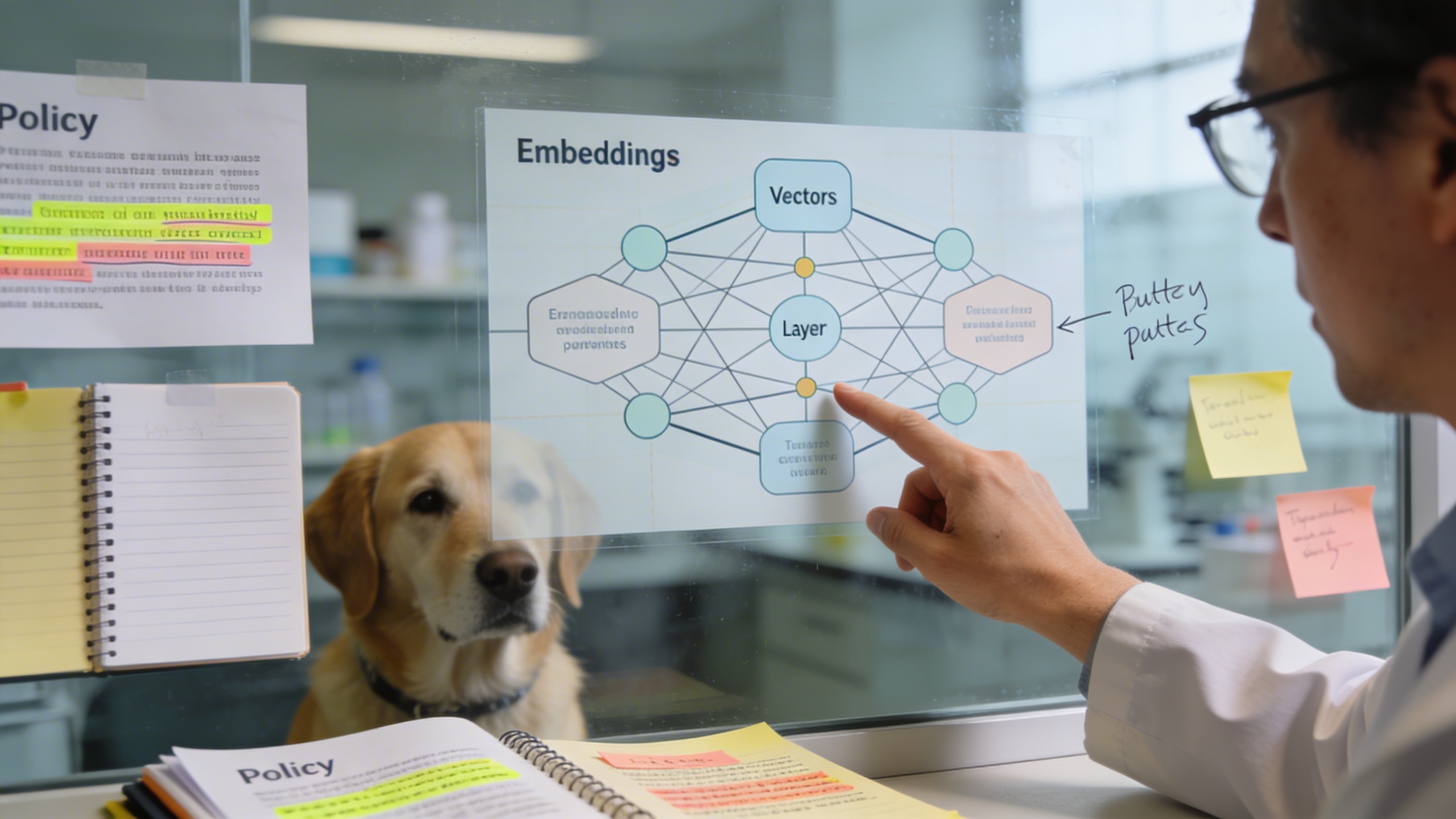
Researcher explaining vector search and RAG with annotated diagrams on a glass wall, illustrating content strategy and SEO optimization concepts

Build the stack, step by step

Step 1: Define truth and scope (don't skip)

Decide what counts as authoritative. Policy manuals, product specs, research archives, CRM notes, even Slack threads if you must—but tag them by reliability. Flag volatile sources (pricing sheets, regulatory memos) for faster refresh. Keep a do-not-trust list too. It sounds fussy; it saves you later when something breaks and you need one lever to pull.

Step 2: Prepare and chunk your corpus

Normalize file formats, strip boilerplate, and segment into chunks sized for retrieval. For longform docs, 512–1,000 tokens with 10–20% overlap works well; legal exhibits may need tighter windows for precision. Store doc-level metadata: source, date, author, access policy, region. Privacy rules belong here, not bolted on at the end.

Step 3: Choose embeddings and a vector store

Pick embedding models that match your domain. Financial research? Prioritize numeracy and table handling. Multimodal assets? Use image-text embeddings for slide decks and diagrams. Vector DB matters too. Pinecone for managed scale and hybrid search; Weaviate for modular pipelines; FAISS for cost-conscious deployments. Configure distance metrics and filters so you can narrow by date, region, or security label without re-indexing.

Step 4: Design your retriever

Set k (the number of chunks to retrieve) and play with hybrid search—sparse + dense—to balance recall and precision. Add re-ranking with a cross-encoder when answers must be razor-sharp. Then layer a query transformation step: paraphrase and expand acronyms before hitting the index. You'll recover intent from cryptic prompts like a pro analyst would.

Technical Implementation Notes

Numbers keep everyone honest. HELM's latest evaluations show hallucination rates dropping from the mid-20s to low single digits once RAG and guardrails are stitched together. Enterprises are logging 90% fewer incidents, which feels wild until you see how much power you get from enforcing citations and blocking non-sourced claims.

Step 5: Orchestrate the generator

Give the model a job: answer strictly from retrieved context, cite each claim, and decline when evidence is missing. Use structured prompts with sections—Task, Context, Constraints, Output format. If you need speed, run a fast model for draft and a slower one for verification or citations. Latency matters; so does the confidence to say "can't answer with current sources."

"RAG + vector search + guardrails isn't a patch; it's the new OS for trustworthy AI."

Step 6: Install guardrails—multiple layers, not just one

Think of guardrails as a net, not a wall. Put some before retrieval (prompt injection filters), some after retrieval (context hygiene, PII scrubs), and some post-generation (fact-checkers, policy validators, toxicity and compliance screens). Enforce citations at the schema level: no citation, no sentence. And add a source coverage rule: if fewer than X distinct sources are cited for a complex claim, force a follow-up retrieval.

Step 7: Close the loop with evaluation

Track hallucination rate, citation coverage, answer completeness, and latency. For truthfulness, run weekly canary tests on a fixed set of gnarly prompts. Build automatic red-team suites: jailbreak attempts, prompt injections, and RAG poisoning probes against your own store. When something fails, study the trace, not just the output. That's where the fix lives.

Step 8: Production hardening

Cache hot queries. Warm indices before peak hours. Shard large corpora by topic and region. Add circuit breakers that degrade gracefully: if guardrails time out, return a retrieved snippet with disclaimers instead of a freewheeling guess. And log everything—retrieval IDs, ranker scores, guardrail outcomes. Debugging without logs is like flying at night without instruments.

Content strategist drafting briefs with embedded citations and a visible sitemap, highlighting SEO optimization and content marketing workflows

Real-World Results & Revenue Opportunities

Operational playbook for content strategy and SEO optimization

Your growth engine loves this stack. Why? Because factual accuracy scales production. Marketing teams can draft briefs, product pages, and support answers with citations baked in. Less back-and-forth, fewer rewrites. The quiet win: search visibility improves because you actually cite verifiable data, and that bleeds into better dwell time and trust signals.

Set up two pipelines. First, a research-to-brief flow: queries hit the vector store, snippets get pulled with citations, and the LLM composes a brief with key facts and gaps. Second, a brief-to-asset flow: the model crafts variants for web, email, and social, while a guardrail enforces claims only from approved sources. This is marketing automation with a conscience.

Real-World Results

Perplexity's overhaul in early 2026 paired RAG with FAISS and custom guardrails. User-reported hallucinations fell from 12% to 1.2%, and Pro subs spiked into the millions. That jump wasn't just speed; it was visible reliability—answers arrived with receipts.

JPMorgan Chase ran a 10TB deployment with Weaviate vectors and NVIDIA NeMo Guardrails. Analyst accuracy moved from 78% to 97%, freeing hundreds of thousands of hours. Think about what that does to decision lead time in volatile markets. You don't just get fewer errors; you get time back, which compounds.

BBC Success Story

BBC's pilot used Pinecone and Anthropic guardrails for newsroom fact-checking. Over a thousand stories, hallucinations fell nearly nine-tenths. The headline isn't the drop—it's the discipline. Every claim pinned to a source that could be inspected later. Auditable truth at newsroom speed.

Ten agentic playbooks to grow revenue once the rails are in

Once hallucinations drop, you can push AI into places that touch revenue without flinching. Here are ten practical plays—spanning operations to marketing—that teams are shipping this quarter.

  1. Sales research concierge: Auto-compile account dossiers from CRM, earnings calls, and news. Guardrail blocks claims without citations; vector search ensures relevance.
  2. RFP answer engine: Retrieve past proposals, legal clauses, and product specs. Cite each paragraph. Flag contradictions for human review.
  3. Pricing intelligence agent: Track competitor pages and analyst notes. Only publish deltas with dual-source confirmation.
  4. Support deflection with receipts: Serve answers that quote manuals and solved tickets. When confidence dips, route to human with the exact snippet trail.
  5. Field enablement briefs: Region-filtered retrieval for regulatory and inventory differences. Guardrail prevents cross-region data bleed.
  6. Thought-leadership factory for content marketing: Pull peer-reviewed papers and internal research. Generate drafts with live citations and a changelog.
  7. SEO optimization planner: Cluster queries by semantic intent, map to owned content, and surface gaps with source-backed insights, not vibes.
  8. Churn-risk outreach agent: Retrieve account health signals and past interactions; draft messages that cite the exact incidents customers care about.
  9. E-commerce spec guardian: Validate PDP claims against vendor feeds. When specs change, auto-issue PRs to the CMS with annotated diffs.
  10. Social media marketing responder: Summarize trending threads, answer with links to your docs, and refuse unverified claims. Speed plus credibility.

Implementation worksheet

Use this to move from slideware to production in two weeks.

Week 1

  • Inventory sources; tag trust levels; define PII boundaries.
  • Chunk and index 500–2,000 documents with embeddings; stand up a vector DB.
  • Prototype retriever with k=5–10, add hybrid and re-ranking. Wire a minimal prompt with enforced citations.
  • Install basic guardrails: injection filter, citation validator, toxicity screen.

Week 2

  • Add post-generation fact-check against retrieved context; block unsupported claims.
  • Stand up canary tests with 100 prompts; measure truthfulness, coverage, and latency.
  • Integrate with your CMS/CRM for one live use case—support or sales research is fastest.
  • Ship observability: logs, traces, and dashboards. Plan the re-index cadence.

Then, iterate. Kill what's brittle. Double down on what lands. When someone asks, "Can we trust this?", don't wave at a model card. Show the trace.

Final note, because teams forget when the demo dazzles: the goal isn't zero mistakes; it's auditable truth at speed. With RAG, vector search, and guardrails working in tandem, you don't just reduce hallucinations—you earn the right to scale.