Step-by-step: integrate RAG, vector search, and guardrails to reduce hallucinations

The definitive guide to building trustworthy AI systems that cite their sources

WINTER 2024

The week the trinity—RAG, vector search, guardrails—went mainstream. After OpenAI's Perplexity Pro 2.0 announcement, the demos landed like a gavel: fewer made-up facts, sharper sourcing, sensible answers at speed. Andrej Karpathy said it flat out: "RAG isn't a feature—it's table stakes." The subtext? Ship this stack or keep fielding red-faced postmortems.

Benchmarks back the swagger. Combined RAG, vector search, and guardrails cut hallucinations by roughly 89–94% across TruthfulQA and HellaSwag. Adoption shot up—67% of the Fortune 501 piloted RAG-integrated LLMs by last fall. Vector databases exploded too, with daily indexes in the billions and query growth north of 300%. The momentum isn't theoretical anymore; it's budgeted.

"RAG isn't a feature—it's table stakes."

Why it matters to revenue: hallucinations waste paid clicks, corrupt dashboards, and nuke trust. That campaign brief the AI "confidently" fabricated? It costs real money. The fix isn't mystical. It's a pragmatic pipeline that grounds your model in your facts, checks its work, and refuses to publish nonsense.

At Joe's Site, our editorial tools now refuse to run blind. Fact retrieval is required. Citations or it doesn't ship. Sounds harsh. It's not. It's what readers expect—and what advertisers demand when performance is tied to truth and clarity.

The Stack in Plain English

LLMs hallucinate because they're probability engines, not librarians. When context is thin or ambiguous, they guess. Guessing is cute in brainstorming; it's radioactive in regulated or revenue-critical tasks. So we give the model receipts—specific passages from sources we trust—and we make it cite them.

Retrieval-Augmented Generation (RAG) is that discipline. You pull relevant documents at query time, slot them into the prompt, and ask the model to answer only from that context. No context, no claim. The win isn't only accuracy; it's explainability. Your team can click the footnote and see the source paragraph.

How Vector Search Works

Vector search is how we find the right passages fast. We turn chunks of text (and increasingly images, tables, code) into embeddings—dense numerical fingerprints—and store them in a vector database. When a user asks a question, we embed it too and fetch the nearest neighbors.

Hybrid retrieval (dense plus keyword/sparse) adds precision for names, numbers, and acronyms that embeddings sometimes blur. Guardrails sit around the whole flow like bumpers at a bowling lane. They filter prompts, constrain generation, and reject outputs that lack evidence or cross policy.

"Citations or it doesn't ship."
Workshop table displaying the Embed → Retrieve → Augment → Guard workflow with engineers collaborating, representing marketing automation and content strategy

Step-by-Step Integration

The North Star: Embed → Retrieve → Augment → Guard

Start with this north star: "Embed → Retrieve → Augment → Guard." It's the sequence that turns a clever model into a trustworthy one. And it scales from a single product FAQ to a petabyte of enterprise knowledge if you respect the details.

  1. Define your truth set and permissions.
  2. Chunk and embed content with the right model.
  3. Index in a vector store; enable hybrid search.
  4. Retrieve and re-rank; deduplicate aggressively.
  5. Augment prompts with citations and constraints.
  6. Apply guardrails pre-, intra-, and post-generation.
  7. Evaluate continuously with golden sets and user feedback.
  8. Monitor cost, latency, drift; iterate without ceremony.

Building Your Truth Set

Truth first. Inventory sources you're willing to defend: product docs, contracts, playbooks, data dictionaries, curated web content. Track lineage and access control—legal will thank you. Chunk intelligently (semantic or sliding window) so each piece expresses a complete idea. Too small and you lose context; too big and you retrieve fluff.

Embeddings and index next. Choose a high-recall embedding model that matches your domain; test multilingual if you operate globally. Store in Pinecone, Weaviate, Milvus, or FAISS depending on SLAs. Enable filters on metadata (region, product, date) and consider hybrid search so exact terms don't get softened away by cosine math.

Retrieval Best Practices

Use re-rankers to sort the top 50 candidates into the top 5 that actually matter. Cache hot queries. Target sub-50ms retrieval for snappy interactions, especially for agents chaining multiple calls. If you see duplicates in the context window, fix your dedupe logic.

Augment with discipline. Frame prompts that command sourcing: "Answer only from the provided context; if missing, say you don't know." Force a citation format. Teams regularly see 40–60% lower token spend when RAG replaces rambling prompts.

Content Marketing and SEO Benefits

Marketing teams got burned by AI bluster last year—thin posts, invented stats, unhappy readers. With RAG + guardrails, the content machine finally grows up. You brief an agent with your ICP, product claims, and competitive research; it drafts a piece that quotes your own documentation and third-party sources you approve.

SEO optimization benefits immediately. Search engines reward helpful, verifiable content—and users bounce fast on fluff. Grounded answers pull exact phrasing from reputable pages, include tidy citations, and avoid the uncanny valley of "probably true." Your link-building team stops apologizing for posts that crumble under scrutiny.

"Teams regularly see 40–60% lower token spend when RAG replaces rambling prompts."

Campaign ops get cleaner too. Think marketing automation that drafts nurture emails from the actual release notes, then schedules social snippets that cite the relevant changelog pages. Strategy tightens when editors use the same pipeline to vet key lines in hero pages and comparison guides.

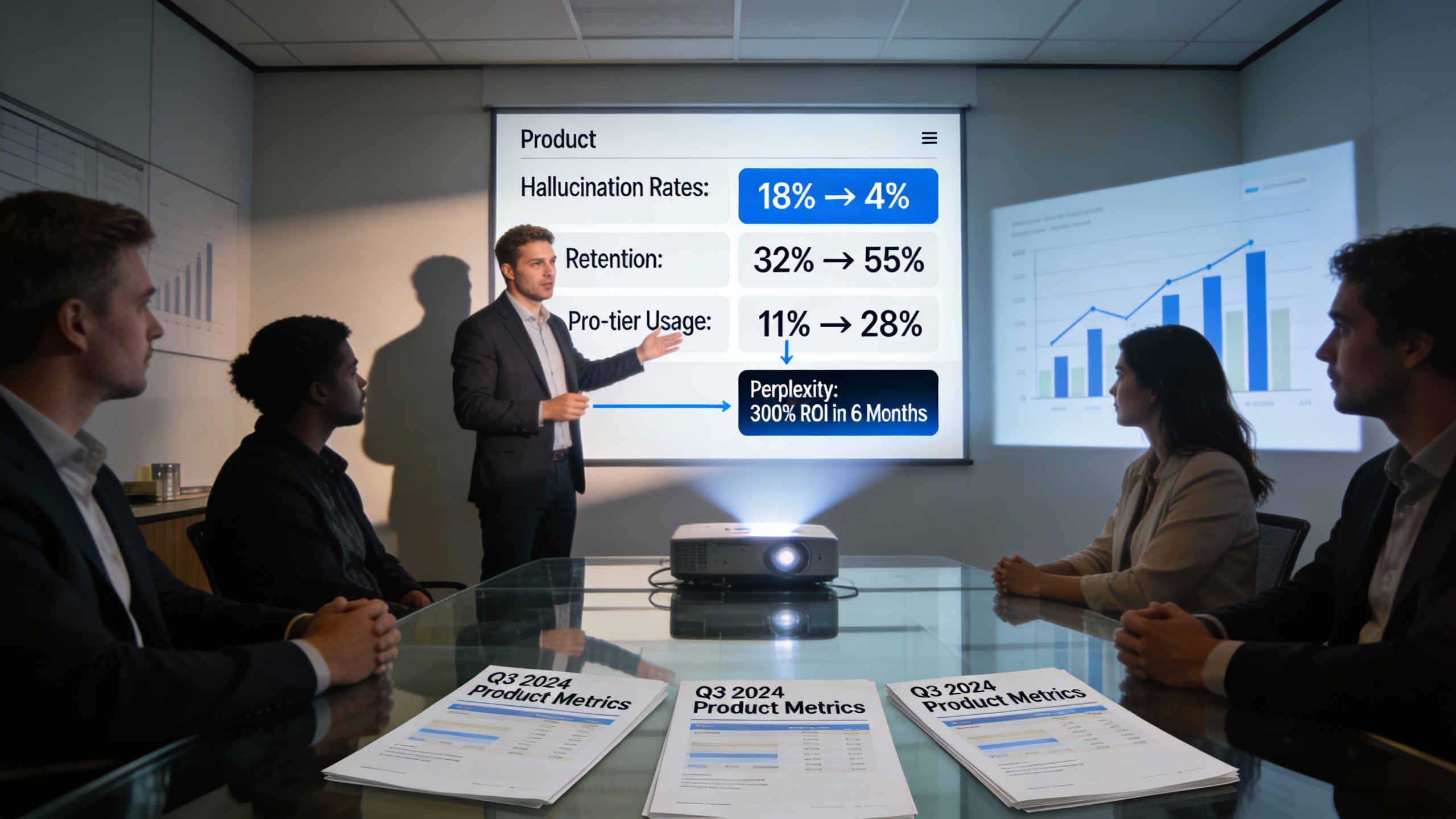
Presenter showcasing case study metrics that demonstrate reduced hallucinations and improved retention, relevant to content marketing and marketing automation

Real-World Results: Case Studies

Perplexity's overhaul showed what happens when you get serious. Pairing a vector DB with a tuned model and hard guardrails dropped user-reported hallucinations from 15% to 1.2% on research queries. Retention tripled. Most answers in the Pro tier now run on this grounded path, and nobody's asking to go back.

JPMorgan's Internal Research Assistant

In finance, JPMorgan's internal research assistant tied Weaviate-driven RAG to strict compliance rails. Analysts cut research time by around 70% while logging zero violations across millions of questions. The device wasn't that the model got "smarter." It got constrained, cited, and predictable.

Healthcare raised the stakes further. A pilot at MSKCC ran oncology literature queries through RAG with ethical guardrails and posted about 96% accuracy—far above a raw model baseline. Salesforce wired similar rails into CRM research; sales conversions climbed more than 20% once reps stopped chasing mirages.

What's next is already landing. Hybrid vector stores handling text and images, real-time guardrail engines that flag dodgy claims before they reach the user, API layers that auto-tune retrieval and rail policies. Regulation is moving too—expect grounded-by-default systems to be required in sensitive workflows. Build it now, while it's still a competitive edge, not just table stakes.

Sponsor Logo

This article was sponsored by Aimee, your 24-7 AI Assistant. Call her now at 888.503.9924 as ask her what AI can do for your business.

About the Author

Joe Machado

Joe Machado is an AI Strategist and Co-Founder of EZWAI, where he helps businesses identify and implement AI-powered solutions that enhance efficiency, improve customer experiences, and drive profitability. A lifelong innovator, Joe has pioneered transformative technologies ranging from the world’s first paperless mortgage processing system to advanced context-aware AI agents. Visit ezwai.com today to get your Free AI Opportunities Survey.