Supply Chain Revolution

How AI Forecasting Freed $2.5 Billion in Cash and Transformed Revenue

WINTER 2026 EDITION

The supply chain story used to be a slog of spreadsheets and safety stock, a game of guess-and-hope that tied up cash like it was nothing. Then the floor shifted. AI-driven forecasting matured, data streams multiplied, and the winners started freeing money at a scale that sounds exaggerated—until you look at the numbers. We'll go deep into how one automation program unlocked cash and sales, where the friction lives (because there's always friction), and how to build the operating model that doesn't crumble the moment the world gets weird again.

"When one giant runs tighter, everyone else feels the oxygen thin out"

Let's start with a live wire: Walmart. In Q4 2025, it credited autonomous forecasting with freeing $2.5 billion in working capital—real money, fast—by cutting overstock 28% and hitting 92% accuracy at the SKU–store level. That isn't a rounding error. That's a CFO-smiles-on-the-earnings-call moment that reshapes the entire conversation about inventory. And the competitive pressure is immediate; when one giant runs tighter, everyone else feels the oxygen thin out.

But this isn't just a mega-retailer flex. McKinsey clocked a 350% spike in enterprise supply chain AI investments since 2023. Gartner says adopters are clawing back 35–65% of excess inventory and pushing forecast accuracy toward 85–95%. Translation: cash unlocked, revenue lifted, bullwhip tamed. It's not neat or uniform, but the direction is obvious. Businesses that automate demand sensing and replenishment are turning the chain into a growth engine, not just a cost center.

Why Forecasting Consumes Cash

Every ops leader knows the paradox. To protect service levels, you stack buffers on buffers. Those buffers get expensive. They also hide problems: lead-time slip, supplier noise, latent demand shifts. When volatility spikes—geopolitics, weather shock, a viral trend—your buffers overshoot in the wrong direction. And cash is trapped in the wrong SKUs at the wrong nodes. Most teams try to fix it with heavier planning cycles. More meetings. More overrides. Not scalable.

AI-driven automation tackles the core constraint: the signal. Legacy ERP forecasts are largely backward-looking. Today's best systems fuse multimodal data—historical sales, point-of-sale streams, supplier APIs, IoT telemetry from pallets and trucks, regional weather, port congestion, even social sentiment from Reddit and TikTok—to sense demand two to eight weeks earlier. You get a probability distribution, not a single number. Planning becomes a set of policy choices (service targets, cash constraints, carbon goals) rather than a gut feel baked into Excel.

The Modern Data Stack

In practice, the system ingests data hourly, refits models daily, and recomputes reorder points continuously. Edge AI in the warehouse can trigger zero-touch replenishment; store-level models can account for hyperlocal quirks. The kicker: when your safety stock is grounded in real variance, not the ghost of last quarter, you can pull it down—hard. That's cash liberation.

There's a second-order effect, too. Stockouts crash trust. Eliminate them, and revenue rises. BCG found firms with AI-optimized chains lifted sales 10–20% on better availability. You don't need a complicated story when a shopper finds the product they came for. That's the conversion moment, right there in the aisle.

"Cash is trapped in the wrong SKUs at the wrong nodes"
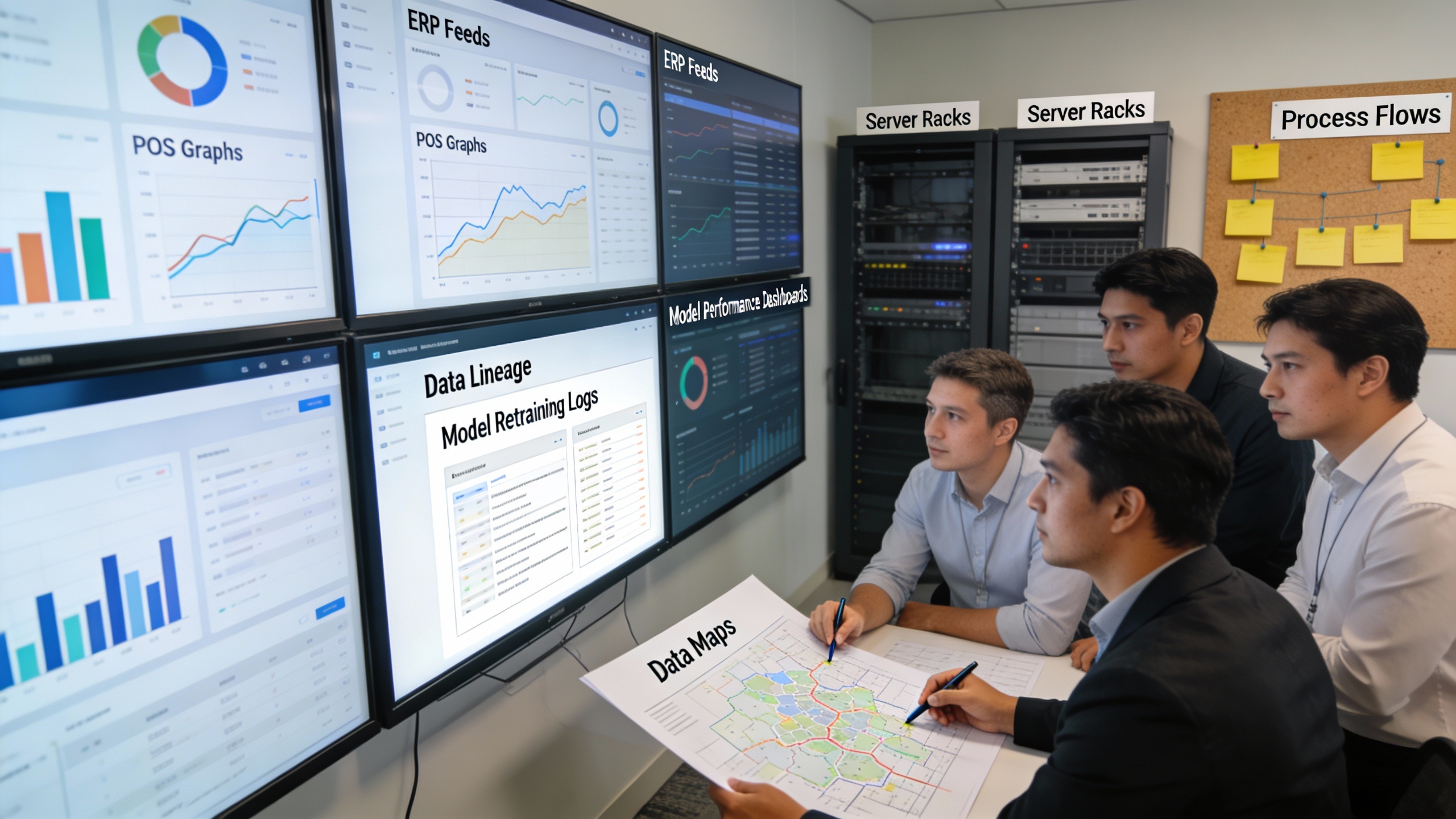
Cross-functional analytics team collaborating on model rollouts and data pipelines for supply chain forecasting, relevant to content strategy and SEO optimization

Inside a Real Rollout

Picture a consumer goods company with a few dozen brands, a messy ERP inheritance, and regional planners stretched thin. The team's mandate: lift service levels, free working capital, and build an operating rhythm that won't shatter when a port strike hits. Here's the backbone of what worked.

Data Architecture First

The company deployed a cloud lakehouse that piped in POS feeds, distributor sell-in, supplier lead times, IoT sensor data from trailers, public weather APIs, and a curated social/marketing signal—search interest spikes, creator-driven surges, and anomaly flags from social media marketing campaigns. They also stitched in procurement schedules and production capacity. No more fragmented truth. One canonical layer, partitioned by SKU–location–week with late-binding joins so new signals could be added without a six-month rebuild.

Modeling Second

They used a mix: gradient-boosted trees for short-term promotional effects, probabilistic state space models for seasonality and regime shifts, and transformer-based sequence models for cold-start and cross-category transfer learning. The ensemble produced a full predictive distribution, not just a mean. Importantly, variance estimates fed directly into safety stock calculations. The business could trade cash for service with intention—dial the slider, watch cash swings in dollars, not abstractions.

The Cash Math That Wins The Room

Before automation, safety stock sat at 45 days on average for the top 200 SKUs. After three months, it fell to 24 days with service levels flat-to-up at 97–98%. Working capital released: $290 million. Payback in under two quarters. Forecast error (MAPE) dropped 52%. Stockouts halved. These are not vanity metrics. They show up in the P&L and in the breathing room your planners feel every Friday afternoon.

Decisioning Last

The team codified replenishment policies as explicit logic: if expected service probability dips below target, raise expediting thresholds; if lead-time variance spikes, trigger automated supplier ETA verification; if a demand spike aligns with influencer-driven traffic, pull forward production an extra batch only if contribution margin clears a floor. Crucially, a "human-in-the-loop" stagegate handled edge cases—high-margin launches, regulatory constraints, and anything that smelled off. No one wants a black box moving millions of dollars without recourse.

"Forecast error dropped 52%. Stockouts halved."
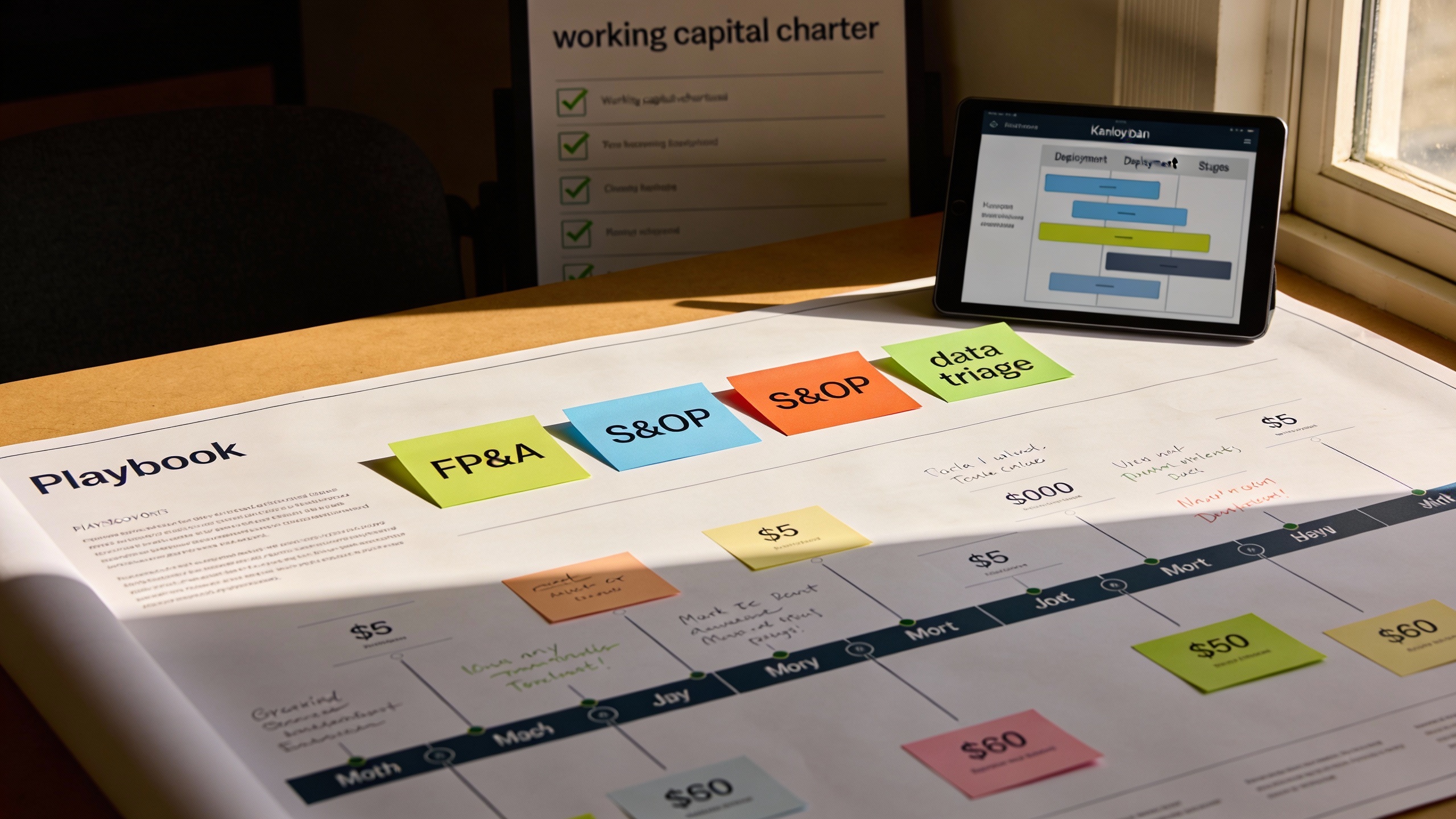
Workgroup playbook and timeline for an autonomous forecasting loop laid out on a table, demonstrating content strategy and marketing automation crossover

The Headline Examples Everyone Cites (For Good Reason)

Walmart's public numbers made investors sit up. Azure AI and an autonomous loop pushing granular forecasts at store level, ingesting 2.5 petabytes daily, slashing inventory 28% while revenue grew 4.2% year over year. The story isn't just the models. It's the orchestration—edge processing, supplier APIs, and policy automation that routed around Red Sea disruptions before they were headline news. That's operational foresight, not hindsight postmortem.

Procter & Gamble's Olay engine, powered by IBM Watson and Palantir, carved safety stock in half and bumped beauty segment sales by 7%. It wasn't magic. It was disciplined: SKU rationalization, promotion-aware forecasts, and a loop that learned from misses. During U.S. port strikes, the system predicted 20% demand shifts and adjusted sourcing. Revenue preserved. Cash unfrozen.

Unilever's SAP IBP plus custom ML stack trimmed error by 55% and freed €800 million. The kicker was commodity foresight. Anticipating cocoa shortages let procurement hedge early, saving 12% on cost and nudging margins three points. Forecasting isn't just what customers buy—it's what your suppliers can actually deliver and at what cost.

What's Changed in 2026

Three things: the cost to get started, the quality of signals, and the cultural willingness to trust machines with big levers. Hyperscalers have made plug-and-play real enough for midsize firms. Social sentiment, weather, and geopolitics feed models with texture, not just volume. And after a few very public wins—and a few bloody-nose disasters blamed on outdated systems—boards now sponsor the shift. Timelines have shrunk. Expect year-one ROI in the 3–5x range if you pick your battles and govern the data.

Marketing Meets Operations

Now the fun part—revenue. Forecasting precision doesn't just protect shelves; it informs the entire go-to-market machine. When your system detects a likely regional surge, the marketing team can pulse spend with confidence, not intuition. That's where the growth compounding starts.

Think about it: your content strategy should be in conversation with inventory. If the forecast flags a short window where supply is strong and demand is rising, you queue content marketing that steers demand to SKUs with headroom. That's not manipulation—it's alignment. Even SEO optimization benefits: long-tail pages for in-stock variants capture queries the week they spike, not six weeks later. Search intent meets actual availability. Everyone wins.

The Playbook: Building an Autonomous Forecasting Loop

  1. Inventory is a finance story. Start with a working capital charter owned jointly by FP&A and supply chain. Target a dollar figure for cash release with explicit service-level floors by segment.
  2. Data matters more than model cleverness. Lock in reliable supplier ETAs with API SLAs; instrument key lanes with IoT; fix product hierarchies.
  3. Ensemble, don't overfit. Use a stable backbone (state space) plus reactive learners (GBMs, transformers). Calibrate prediction intervals obsessively.
  4. Close the loop. Autonomy without policy is chaos. Define replenishment rules, expedite thresholds, and exception queues.
  5. Measure relentlessly. Track MAPE, weighted MAPE, bias, service level by decile, turns, cash released, and lost sales recovered.
  6. Scale with restraint. After two pilot business units prove ROI, roll to adjacent categories with similar demand physics.

You're not buying math. You're buying a cash machine with the discipline to say no—to excess, to hunches, to excuses. When it's humming, the chain stops jerking around and starts compounding value. That's the game.
Sponsor Logo

This article was sponsored by Aimee, your 24-7 AI Assistant. Call her now at 888.503.9924 as ask her what AI can do for your business.

About the Author

Joe Machado

Joe Machado is an AI Strategist and Co-Founder of EZWAI, where he helps businesses identify and implement AI-powered solutions that enhance efficiency, improve customer experiences, and drive profitability. A lifelong innovator, Joe has pioneered transformative technologies ranging from the world’s first paperless mortgage processing system to advanced context-aware AI agents. Visit ezwai.com today to get your Free AI Opportunities Survey.