How to Deploy Multimodal AI for Product-Led Growth

Transform Upsell Personalization with Vision, Voice, and Context-Aware Intelligence

WINTER 2025

Your customer opens the app, snaps a photo of their setup, drags in a sketch, mutters a quick voice note. The product understands—visually, textually, contextually—and offers the next best action without a sales rep in sight. That's not fantasy. It's the new baseline for product-led growth when multimodal AI gets a proper seat at the table.

Teams piloting this stack aren't nibbling at the edges. They're posting bigger lifts than years of A/B tests ever delivered: 52% higher customer lifetime value from personalized upsells vs. text-only systems, a 67% jump in upsell conversions when vision-language models interpret what users actually show you, and 3.2x faster feature adoption through in-app visual demos. Numbers with teeth.

"Multimodal AI turns PLG from guesswork into precision—upsells feel like help, not a hustle."

Multimodal means your AI stops guessing from text alone and starts fusing clues across images, voice, screen recordings, and clickstreams. The win: upsells and expansions that feel like product help—not pop-up ads wearing a lab coat. Let's build the playbook so this isn't stuck in your backlog.

Why Multimodal AI Now

Product-Led Growth Meets Content Strategy

Text-only personalization leaves a lot on the floor. Satya Nadella called it bluntly: "Text alone misses 70% of user intent; multimodal deployment in PLG stacks like Amplitude + Gemini unlocks hyper-personalization at scale." Think about a user's session recording showing hesitation over a complex workflow, or a photo of their workspace. That's intent, untyped—and totally invisible to legacy funnels.

Precision matters because PLG lives or dies on tiny frictions. A model that recognizes the user's uploaded diagram and instantly offers a premium template or an advanced block isn't "marketing" in the old sense; it's product coaching that happens to drive revenue. Andrew Ng's bet rings true here: visual-first interactions (sketches, AR try-ons) create power users quickly—and power users convert.

Content Evolution

Your content strategy doesn't just push articles; it powers in-product guidance: short visual walkthroughs, annotated screenshots, tailored videos. The same assets that support blog automation or social media marketing become atomic components the model can pull into the moment, matching what the user is looking at right now.

Latency used to be the buzzkill. Not anymore. Edge and serverless inference—Vercel's AI SDK is a handy example—drop response times under 200ms, which is the line between delightful and clunky. Mix that with modern vision-language models (GPT-5V, Claude 3.5 Multimodal, Llama 4 MM, take your pick) and you can render upsell nudges that feel native, not nudgy.

Ethically, the tide is shifting the right way. Federated learning now slots into production stacks without drama, GDPR 2.0 compliance is table stakes, and privacy-by-design isn't a slogan—it's a gating requirement for any serious deployment. Do it right and customers reward you with trust. Do it sloppy and your churn chart will make the point fast.

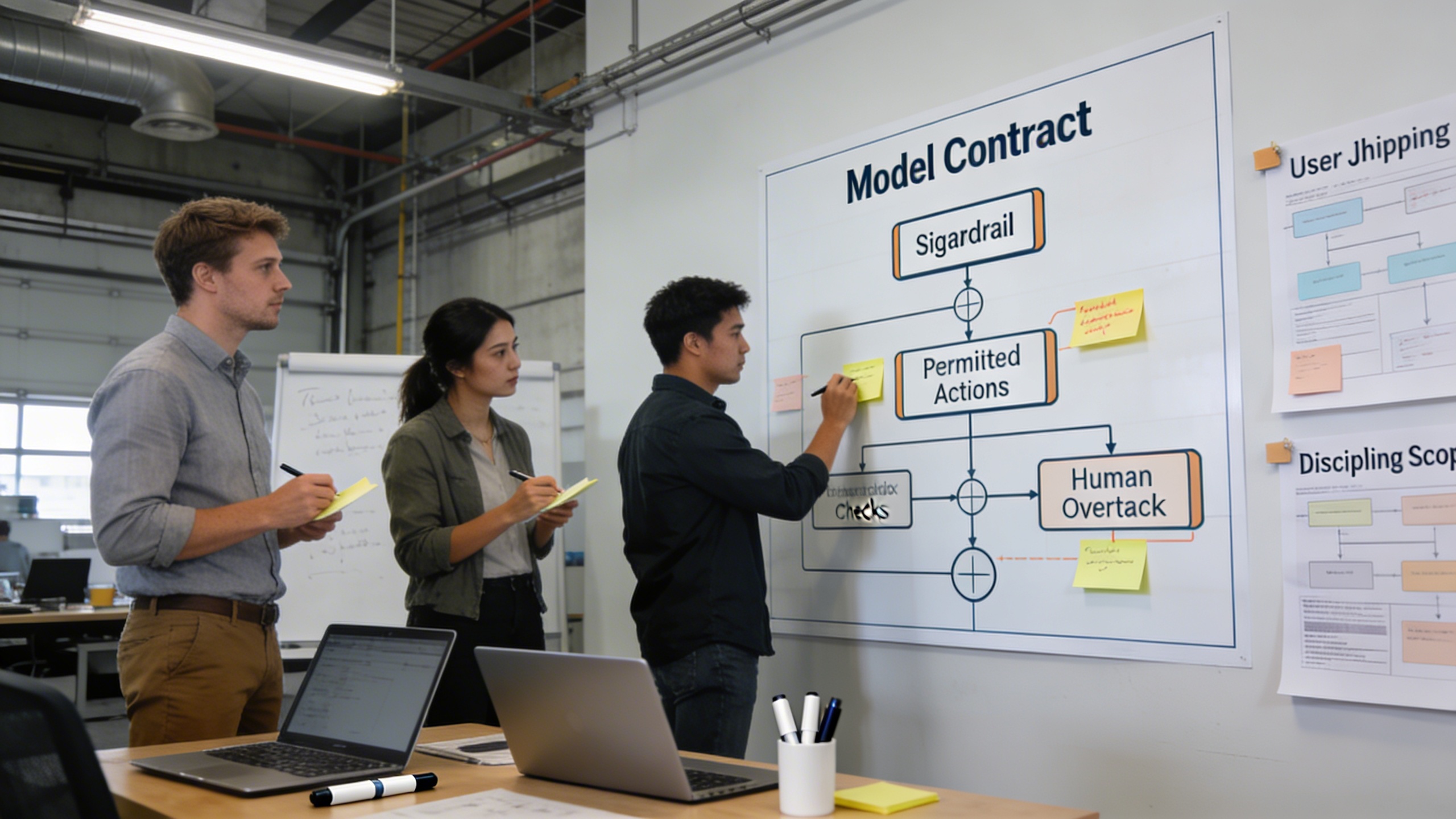
Cross-functional team refining a model contract and guardrails on a wall flowchart to speed deployment, reflecting marketing automation governance

Deployment Playbook

Building the Foundation

Start with a crisp contract between your product and your model: what signals the model sees, what actions it can take, and what the human override looks like. Guardrails create speed. Paradoxical? Feels that way—until you ship twice as fast because nobody's arguing over scope creep.

The skeleton key is your event model. You're not just feeding clicks and feature flags; you're piping in images, short clips, even annotated screenshots. Each gets hashed, permissioned, and mapped to a consented user profile. When someone records a 20-second screen share in onboarding, that's gold for the model to spot blockers and propose premium features that remove them.

Deployment Steps That Actually Land

  1. Scope outcomes: pick two revenue moments (e.g., premium template upsell, advanced analytics add-on) and define success metrics: conversion %, time-to-adopt, CLV impact.
  2. Data plumbing: consolidate product analytics (Amplitude/Mixpanel), zero-party uploads (with explicit consent), and support transcripts into a unified store. Start lean; enrich later.
  3. Model selection: test 2–3 vision-language backbones against your domain images and UX flows. Evaluate on latency, hallucination rate, and clarity of rationales. Keep receipts.
  4. Edge inference: ship lightweight models to the client or edge nodes for the highest-traffic moments; offload heavier analysis to serverless functions with caching. Keep p95 < 200ms.
  5. Action catalog: predefine upsell components (inline hint, guided overlay, AR preview, 30s micro-demo). The model picks, but design controls the menu.
  6. Safety gates: require consent tagging for any user-provided media, strip PII, and log model outputs to an auditable trail. SOC 2/ISO 27001 don't slow you down if they're baked in.
  7. Human-in-the-loop: route edge cases to product specialists. Feedback updates prompts, retrieval corpora, and allowed actions. Tight loop, no drama.
"The Watcher sees, the Planner pairs intent with assets, the Enactor triggers the right UI element—crisp, reversible."

Agentic patterns help. A small agent trio—a Watcher that monitors signals, a Planner that pairs intent with assets, and an Enactor that triggers the right UI element—keeps responsibilities clean. The Watcher sees a user hover on an integration page for 40+ seconds after uploading a spreadsheet; the Planner pairs that with a 3-step micro-demo; the Enactor launches an overlay that previews the premium connector and a 14-day trial. Crisp. Reversible.

Content and Standards Integration

On content, get tactical. Shorten your media. Models perform best when they can retrieve and rank atomic clips: 15–45 seconds, one concept each, captioned. The same discipline that helps digital marketing automation suddenly helps PLG: you're basically crafting snackable building blocks the system can mix and match mid-session.

Don't cheap out on evaluation. Beyond offline accuracy, run holdout cohorts in production: feature adoption vs. control, upsell conversion delta, and downstream retention after 30/60/90 days. If a nudge boosts checkout but torches week-4 usage, it's not working. Measure the whole arc.

Standards and Integrations That Won't Bite You Later

Consent and storage: tag every visual artifact with purpose, expiry, and scope; purge automatically on request. Federated learning if you're handling sensitive visuals, plus strong device-side encryption. Connectors: Intercom or in-app messengers for human follow-up, Amplitude for path analysis, and a retrieval store tuned for multimodal assets. Keep prompts versioned in Git. Yes, really.

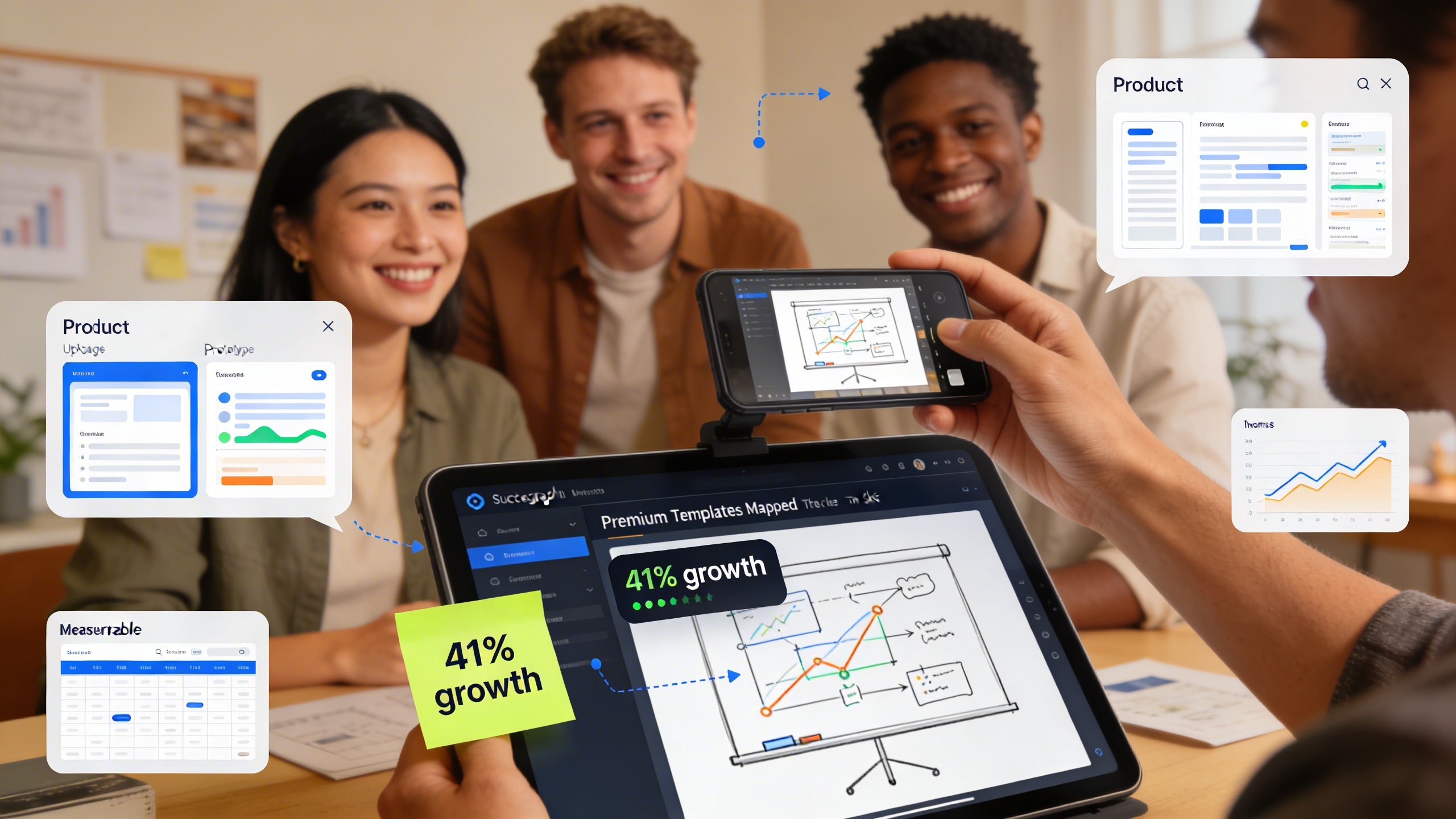
Designer uploading a whiteboard diagram that maps to premium templates, illustrating a case study of product-led growth and digital marketing automation

Personalization That Sells

Multimodal Upsells and Marketing Automation

Upselling inside the product works when it's unmistakably useful. That means your nudge reflects what the user's doing right now, not a persona you guessed last quarter. Vision-language models can tell when someone's tinkering with a complex chart from a screenshot; the right move is an inline premium visualization preview, not a sidebar ad begging for attention.

Here's the rhythm that converts: detect intent from current context; surface a micro-demo or AR try-on that shows the benefit in their world; offer a click-light upgrade (apple-pay-simple, SSO-recognized pricing, no forms); follow with a success checklist. The checklist matters—it locks in value and protects retention so your conversion lift sticks.

"PLG isn't allergic to outbound; it's allergic to irrelevance."

Bring your lifecycle tools into the room—quietly. PLG isn't allergic to outbound; it's allergic to irrelevance. Trigger a short recap email or in-app message only if the user viewed the micro-demo but didn't complete the upgrade. Sync events to your CRM for account context, then let marketing automation backfill education with a light touch. If you're already good at content strategy, you're halfway there: the same editorial instincts fuel the in-product help the model retrieves.

And yes, the bridge to your demand gen stack matters. When a CEO uploads a photo of their warehouse to explore a premium analytics module, social posts and landing pages should mirror that visual angle within hours. This is where blog automation and social media marketing stop being buzzwords and start acting like a distribution flywheel for what the product already proved users want.

At Joe's Site, we've watched teams who honor that handoff outperform by a mile: the product teaches the market in real time, and the market's response trains the product back. Tidy circle. Slightly messy execution. Worth it.

Field Notes: Case Studies That Moved the Needle

Notion's 2025 rollout remains a clean blueprint. By letting users upload rough diagrams and whiteboards, then mapping those visuals to premium templates, they posted a 41% PLG growth surge and $150M in ARR lift in a single quarter. The churn dip—22%—tells the real story: the upsell felt like a solution, not a sidetrack.

Shopify's AR Revolution

Shopify's AR upsell engine is louder. Customers uploaded photos, saw virtual try-ons, and got nudged toward premium themes and subscriptions that matched their style. The result: a 64% upsell acceptance rate and an added $2.1B annualized revenue. Onboarding speed tripled, which changes everything about the payback math.

Slack leaned into screen-share intelligence. By analyzing short clips from workflow walkthroughs, the system flagged when orgs were outgrowing their plan and suggested Enterprise Grid at exactly the right moment. Harvard Business Review tallied a 35% revenue-per-user boost, with 1.2M daily actives converting through in-app nudges that didn't scream 'sales'—they whispered 'less friction.'

And if you're still unconvinced, here's the blunt version from Dr. Elena Vasquez at HubSpot: "Multimodal AI transforms PLG from guesswork to precision: by fusing user session videos, purchase history, and image preferences, upsells become intuitive, boosting revenue 2–5x without friction." Big promise. Bigger receipts showing up every quarter.