Multimodal AI Revolution

How to Deploy AI for Product-Led Growth and Upsell Personalization

AI STRATEGY QUARTERLY 2025

Your product is already talking to users—quietly, constantly. Cursor trails, clipped screenshots, voice notes on support calls, the way someone pauses on a chart and then darts to the docs. That chatter is gold. Multimodal AI for product-led growth lets you listen to all of it at once and translate the murmur into revenue: the right upgrade, at the right moment, in the right medium.

Product-led growth works when the product sells itself. It works even better when the product understands people, not just clicks. Text alone misses the picture-heavy workflows, the micro-gestures, the tone of a frustrated user on a video call. Bring in image, log, audio, and even short video fingerprints, then map them with multimodal embeddings. Suddenly your upgrade prompts feel eerily relevant—because they're.

"Multimodal AI lets you translate user chatter into revenue: the right upgrade, at the right moment."

This is a practical playbook for upsell personalization with AI. No fairy dust. We'll go from data design to agents and guardrails, draw on real deployments from MongoDB, Tempus AI, and ServiceNow, and leave you with clear measurements so you can prove lift—not just hope for it.

From Clicks to Context

A Practical Blueprint

Start with signals. Capture product telemetry, document searches, screenshots users paste into support forms, snippets from session replays, even image diffs of dashboard states before and after a feature is toggled. If your product runs in enterprise, log anonymized traces of failed API calls alongside error toast screenshots. Keep the raw, but also distill: short transcripts from calls; embeddings for every object that matters—user sessions, features, and the content that teaches them.

Unify those signals. Build a thin event schema that tags each artifact with who, when, and why (intent guess), then drop the unstructured payloads into an embedding store. Vector databases with multimodal models let you treat "this image of a configuration screen," "that doc paragraph," and "this snippet of chat" as neighbors. As MongoDB's own experience shows with Voyage AI models inside Atlas, that neighborhood is where personalization finally stops being a guess.

MongoDB Success Story

"Multimodal embeddings unlock PLG at scale; by embedding user interactions with product visuals and logs, we personalize upsells 3x more effectively without sales teams."

Score what matters next. Define feature adoption thresholds, friction signals (repeated attempts, long hovers, back-and-forth tabbing), and aha moments. Use a small propensity model to estimate the chance a user succeeds without help versus the chance they'd benefit from a premium feature or add-on. Feed it behaviors plus nearest-neighbor context: the doc snippet they read, the image they uploaded, the video segment where they got stuck.

Core Steps to Keep You Honest

  • Instrument: capture text, images, short audio, and key UI states.
  • Embed: maintain a consistent multimodal embedding pipeline for parity across data types.
  • Rank: combine propensity, value, and risk-of-annoyance scores.
  • Deliver: render messages inside the workflow, not over it.
  • Learn: label every intervention with outcome and drift signals.
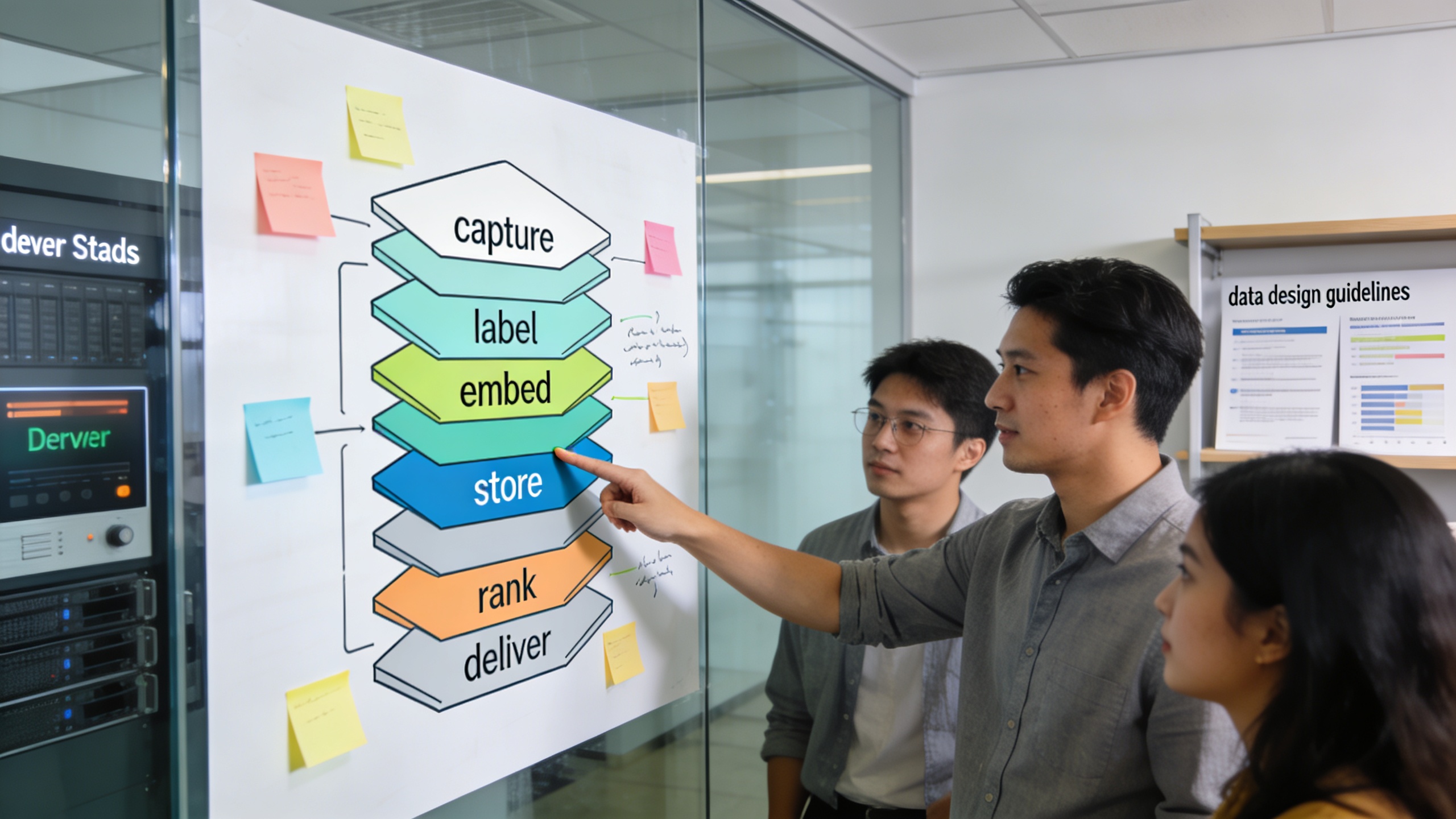
Diagram of a six-layer multimodal stack on a glass board with team annotations, reflecting marketing automation and content strategy planning

Stack and Data Design

Multimodal Stack for Marketing Automation

The stack splits cleanly into six layers: capture, label, embed, store, rank, deliver. Keep your capture SDKs light and cache-friendly. Label sparingly but well—just enough human annotation to ground your models and calibrate your retrieval. Run multimodal embeddings that play nicely with approximate nearest neighbor search. Then treat ranking as a living policy: a blend of rules, models, and safety checks that can be tuned per segment.

Developers have leaned into multimodal retrieval because it closes the loop in context-heavy workflows. MongoDB's integration of Voyage AI's image+text embeddings feeds Atlas Vector Search, and that, in turn, fuels PLG. The result: AI workload growth surged and upgrade prompts tied to feature discovery converted at meaningfully higher rates.

"When a developer searches 'image-to-code workflows,' it now maps not just to docs, but to workloads and sample apps—leading straight to the relevant tier upsell."

Data governance is the seatbelt. Create a consent ledger for anything that touches audio or video. Hash sensitive frames. Redact on the edge. Segment by region to respect data residency, and schedule regular re-embeddings to address model drift. Expect higher compute costs at launch; mitigate with caching, batched inference, and low-latency quantized models for the hot path.

Reference Architecture at a Glance

  1. Client SDKs: capture events, screenshots (with user consent), short transcripts.
  2. Stream processor: classify events; attach minimal PII; route to storage.
  3. Embedding service: text+image model with versioning and shadow testing.
  4. Vector store: HNSW/IVF index; hybrid keyword+vector search for precision.
  5. Policy engine: propensity scoring, fatigue rules, experiment flags.
  6. Delivery: in-app components, email/SMS hooks, help center snippets.

In-Product Orchestration

Agents, Triggers, and Real-Time Judgment

Give the machine a job title. An upsell agent should watch events, sample context with retrieval, ask for evidence, and then decide whether to intervene. It needs guardrails: fatigue caps, safe topics, and blocklists for sensitive content. And it needs accountability. If a user asks why they're seeing this, the agent should be able to show the two or three signals that led to the nudge.

Design a trigger taxonomy that pairs moments of friction with the right creative. Feature friction? Offer a guided step-through and a one-click upgrade to unlock the missing capability. Aha moment? Let them fly, then recap value a day later with a tailored visual comparing their current workflow to the premium one. Misuse? Share a clipped, captioned screen recording that shows the correct flow, then propose the add-on that keeps it from happening again.

ServiceNow Platform Success

ServiceNow's platform updates orchestrated multimodal signals across IT and HR workflows, then timed upgrade recommendations to the moment the user hit their internal limits. The result: a visible uptick in cross-sell and a drop in churn, with self-serve onboarding improved by showing short visual previews at the exact moment new users felt lost.

Pick experiments that learn fast. Multi-armed bandits find the better creative and placement without starving the control. Offline evaluation with recorded sessions (properly consented) lets you run hundreds of candidate prompts overnight to prune the bad ones. Align experience quality with value: a poor-fit nudge might still convert, but it may ding long-term retention.

Creative that Actually Converts

  • Evidence-first: include a tiny screenshot or annotated diagram that mirrors the user's state.
  • Two-tap trials: no credit card; auto-expire; summarize impact when it ends.
  • Social proof that matches the user's role, not a generic logo parade.
  • Fallbacks: if the user closes the prompt twice, offer help, not another pitch.

Measurement, Governance, and Content Strategy

Map a KPI tree before you write a single prompt. At the top: net revenue retention and average revenue per user. Mid-tier: upgrade acceptance rate, feature-in-trial adoption, and fatigue incidents per 1,000 sessions. Ground level: prompt view-to-click, click-to-activate, and activation-to-retain. Track average time-to-value for premium features; if users can't feel the upgrade in under a day, fix the experience before you scale the pitch.

Measure the model as well as the message. Calibrate retrieval quality with labeled relevance checks across text, image, and mixed queries. Run spot audits where humans judge whether the nudge felt fair. Keep a bias dashboard for who gets what prompts by role, region, and device.

"Next year's winners will weaponize context, not volume."

Ship with brakes. A global kill switch for the agent. Per-trigger rate limits. Policy checks that can reject an intervention if confidence or justification falls below the floor. Retain minimal data and honor deletion requests across embeddings and raw artifacts. When a user opts out, the system forgets—fully, not symbolically.

Next year's winners will weaponize context, not volume. We're heading toward a world where 60% of PLG products ship with native multimodal personalization. The advantage won't be who has the biggest model; it'll be who closes the loop the fastest, who can prove uplift without eroding trust. At EZWAI, we've watched teams unlock meaningful revenue by pairing small, well-instrumented models with crisp storytelling and unapologetically human timing. Keep the receipts, keep the receipts, keep the receipts.