How to Deploy Multimodal AI for Product-Led Growth

Transforming Upsell Personalization Through Text, Voice, and Visual Intelligence

WINTER 2025

Your product is already talking to customers. The trick is getting it to listen—and respond—across text, visuals, and voice so every nudge feels uncanny in its timing. That's the promise of multimodal AI in product-led growth: not more pop-ups, smarter ones. The kind that understand context, mood, and intent, then offer an upgrade that feels like a favor rather than a pitch.

This isn't sci-fi rhetoric. Enterprise stacks are shifting fast. With multimodal agents interpreting chat logs, screen captures, and call sentiment, upsell engines are learning to whisper instead of shout. Companies are reporting double-digit conversion lifts and faster revenue per user—because the product finally acts like a top-tier salesperson who remembers everything and never sleeps.

"Multimodal AI isn't just a feature—it's the engine for product-led growth, turning every user interaction into a personalized upsell opportunity at scale."

As ServiceNow's Bill McDermott put it, "Multimodal AI isn't just a feature—it's the engine for product-led growth, turning every user interaction into a personalized upsell opportunity at scale." He's not exaggerating. Their Vancouver release showed what happens when AI agents orchestrate tasks across channels: fewer clumsy steps for customers, cleaner signals for the model, and more precise offers at the exact right moment.

Numbers travel fast in boardrooms: multimodal AI is delivering 25–40% conversion lifts in personalization engines, and in some deployments, AI agents are automating up to 70% of routine sales and customer success tasks. That's not automation for automation's sake; it's product-led use. Less friction. More revenue.

So how do you deploy it without creating a Rube Goldberg machine of models, data pipes, and compliance headaches? Start small, instrument deeply, and build a feedback loop that learns from every interaction—text, visual, and audio—then compounds into better upsell decisions week over week.

The Multimodal PLG Playbook

From First Click to Expansion

Product-led growth works when the product feels alive. Multimodal AI pushes that feeling into the everyday: it sees which features users explore on video calls, it hears frustration in a support message, it reads intent in a feedback form. Stitch those signals together and you get offers that make sense: a premium analytics trial during a screen share, a security add-on right after a governance question, an enterprise tier when the team keeps hitting usage caps.

Start with your golden journeys—the places where trial users become paying customers, and paying customers expand. Instrument them beyond text: capture screen events (securely), transcript snippets, and lightweight sentiment markers. Store these as features the model can learn from, not just logs no one reads.

Multimodal Signal Integration

In practice, that looks like a real-time feature store feeding a multimodal encoder-decoder model. Vision encoders handle UI context (what's on screen), text models parse tickets and chats, audio models lightly gauge sentiment from call tone. You don't need to boil the ocean on day one. A handful of high-signal cues beats a warehouse of noise.

Then build a library of "micro-offers" tied to precise moments. Think in terms of 10–20 nudges—not hundreds. An in-call prompt: "You're screen sharing recordings often—unlock auto-transcription for your next meeting?" A dashboard ribbon: "Your team collaborated with five external domains this week—try advanced sharing controls." Make the intervention tiny, the value immediate, and the upgrade step frictionless.

Guardrails matter. If a user dismisses a prompt twice, back off. If sentiment dips, pause offers and trigger a success check-in. Multimodal personalization can charm or smother; the difference is restraint encoded as policy.

Engineers diagramming scalable data pipelines and inference layers on a whiteboard, demonstrating marketing automation and blog automation planning

Architecture and Data Pipelines

Building Production-Grade Systems

Let's talk guts. A production-grade stack that supports precise upsell decisions needs three things: clean event capture, a modular inference layer, and a feedback loop that actually updates your models. Skip any one and you'll ship prompts that feel generic—or worse, creepy.

Event capture: log the usual suspects (clicks, features used, time in workflow), but fold in multimodal context. Store hashed screen descriptors instead of raw images, lightweight call-level sentiment, and entity extraction from transcripts. Use privacy-by-design patterns: on-device preprocessing where possible, minimal retention for sensitive audio, and consent signals baked into session start. Edge inference helps: it trims latency and lowers cloud burn when the moment for a nudge is measured in milliseconds.

"Every offer creates outcome data—accepted, ignored, dismissed, or annoyed. Treat that as supervised signal."

Inference layer: think agentic, not monolithic. A routing agent decides whether to consider upsell, a policy agent checks consent and frequency caps, a recommender ranks the top 2–3 offers, and a copy agent adjusts tone with guardrails. RAG pipelines pull fresh context—plan limits, recent support tags, security notes—so the nudge doesn't hallucinate. If a user asked about SSO yesterday, the offer shouldn't be about storage today.

Feedback loop: every offer creates outcome data—accepted, ignored, dismissed, or annoyed. Treat that as supervised signal. Retrain weekly on anonymized aggregates. Run A/Bs not only on copy and timing, but on modality mix: sometimes a quiet inline suggestion beats an animated tooltip. Let results drive channel selection.

This is where marketing automation meets product intelligence. Your lifecycle emails, in-app banners, and CS playbooks should all consume the same multimodal features, not parallel truths. Teams ship faster when blog automation, digital marketing automation, and in-product nudges draw from one shared understanding of user intent.

Real Deployment Results

You want proof that this isn't just hype? Consider three rollouts that moved actual revenue, not vanity metrics. Different sectors, same principle: the product noticed something, understood the moment, and offered value that felt obvious.

Unilever's Procurement Portal Success

Unilever wired multimodal AI into its procurement portal: image recognition for supply documents, voice queries for vendor selection, transcripts feeding the recommender. The result? A 35% jump in contract renewals in six months and roughly $150 million in added annual contract value. That's not just a smart prompt—that's an agentic workflow re-routing how buyers decide.

Zoom leaned into in-call context: visuals, transcripts, and feature usage flagged teams who needed premium collaboration tools. Prompts surfaced while the value was in focus—"Based on your screen share, upgrade for AI transcription?" Self-serve upgrades climbed 28%. When the offer arrives at the peak of need, friction melts.

And for balance, look at Salesforce's multimodal Einstein Copilot powering upsells at ADP. It parsed attachments and call audio to guide next-best actions, helping drive a 22% lift in ARPU. Different vendor, similar outcome: multimodal signals priced into the product experience.

What to Build Next Monday

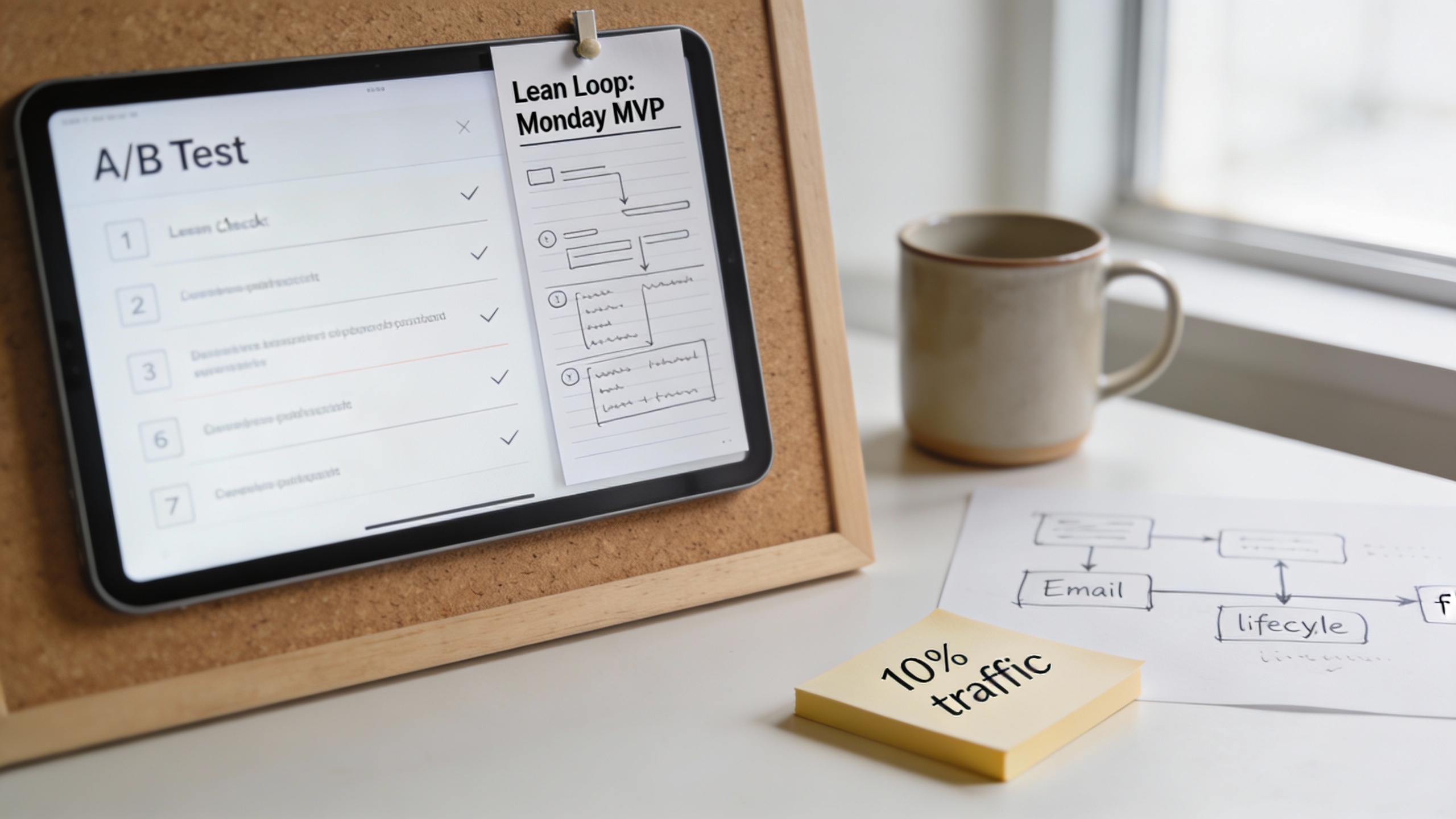
So what do you build next Monday, not next quarter? A lean loop. Pick one journey, one modal signal beyond text, and one micro-offer that ties to clear product value. Ship it to 10% of traffic. Watch the curve. Then widen the loop: two offers, a second signal, a channel handoff to lifecycle email when in-product timing isn't ideal.

Standards matter when you scale. You'll need an offer catalog with IDs, eligibility rules, and frequency caps; a policy store for consent and compliance; and a post-offer pipeline that tags outcomes consistently. Treat your upsell system like a product inside your product, with a roadmap, SLOs, and owner. Yes, it's extra work. No, you can't skip it.

Close-up of a lean loop checklist and sidebar plan for a Monday MVP deployment, illustrating content strategy and social media marketing planning

Checklist: Getting to First Win in 30 Days

  • Map one high-impact journey: trial to paid, or paid to premium add-on.
  • Instrument one non-text signal: screen descriptor or light sentiment.
  • Design three micro-offers tied to immediate value, not vague benefits.
  • Route decisions through policy and eligibility—no wildcat prompts.
  • Run A/B tests on timing and modality; log outcomes cleanly.
  • Review weekly with product, data, and CS—tight loop, fast edits.

Signals, Offers, and Guardrails

Multimodal upsell isn't just a model problem; it's a craft problem. You're shaping tiny moments to feel like service, not sales. When in doubt, anchor on three questions: did we understand the user's context, did we show value instantly, and did we respect their boundaries?

Context: combine signals. A feature hint during a dense dashboard might land as noise, but the same hint after a user searches documentation feels welcome. An image-derived insight about the screen layout can tell your agent the user is stuck on a reporting view; that's your cue for a "Try scheduled exports?" nudge.

Value: make the payoff immediate. Offer a one-click trial of the premium feature and preload it with the user's own data. If they're editing a video, drop them into AI cleanup with their current file. If they're wrangling permissions, show them the before-and-after policy diff.

Two Real-World Implementations You Can Steal

  • Meeting-Moment Upsell: if a user records three meetings in a week without transcription, surface a one-click, time-boxed trial during the next call. Success is measured by trial-to-paid within seven days.
  • Governance Gap Nudge: detect repeated permission edits and recommend advanced roles with a diff preview. Combine a short explainer from your blog automation workflow and a 14-day upgrade credit.

Boundaries: set hard caps. One upsell per session unless the user explicitly clicks "Show more options." Honor dismissals for a cooling period. If the sentiment is negative, pivot to help, not sell. Your policy agent should be ruthless here.

KPIs That Actually Predict Revenue

  1. Offer Acceptance Rate by Moment: not generic CTR, but acceptance when the offer fires at the chosen context.
  2. Time-to-Value Post-Offer: how fast the user experiences the promised benefit.
  3. Churn-Adjusted ARPU Lift: don't let aggressive prompts inflate short-term revenue at the cost of cancellations.
  4. Agent Resolution Mix: percent of upsell flows handled entirely by agents vs. escalated—healthy systems escalate the right stuff.
  5. Latency at Decision Point: sub-200ms wins; sluggish prompts are invisible or irritating.

If you want a single north star, track expansion revenue per active account with attribution to top micro-offers. The Pareto pattern shows up early: a handful of offers carry the quarter.

"Keep the copy human. 'Need more space?' beats 'Our enterprise tier provides enhanced storage scalability.'"

What Success Looks Like in 6–12 Months

Teams that ship this well report 40% faster time-to-value on PLG experiments, material conversion lifts, and operational savings from agents covering the repetitive grunt work. Pricing strategies get sharper when zero-party signals from conversations and screens feed dynamic models. And yes, you'll spot new upsell surfaces you didn't plan—mobile especially, where on-device inference keeps latency low and privacy tight.

Expect a cultural shift too. Product, data science, and marketing sit closer. The playbooks blur. Your lifecycle campaigns and in-app nudges stop arguing over attribution because they're drawing from the same feature store. It feels… calmer. Then the revenue shows up.

And yes, keep the copy human. "Need more space?" beats "Our enterprise tier provides enhanced storage scalability." You're helping, not lecturing.

Sponsor Logo

This article was sponsored by Aimee, your 24-7 AI Assistant. Call her now at 888.503.9924 as ask her what AI can do for your business.

About the Author

Joe Machado

Joe Machado is an AI Strategist and Co-Founder of EZWAI, where he helps businesses identify and implement AI-powered solutions that enhance efficiency, improve customer experiences, and drive profitability. A lifelong innovator, Joe has pioneered transformative technologies ranging from the world’s first paperless mortgage processing system to advanced context-aware AI agents. Visit ezwai.com today to get your Free AI Opportunities Survey.