AI Sales Engine Revolution

From Lead Scoring to Outreach—Building Revenue Growth That Actually Works

APRIL 2026 EDITION

Most sales teams don't have a lead problem. They have a judgment problem. Too many names enter the funnel, too little signal rises to the surface, and reps end up burning their best hours on prospects who were never going to buy in the first place. That's where an AI sales engine changes the economics. It doesn't just rank leads faster. It rewires how a company notices intent, decides who matters, and reaches out with timing that feels uncannily well judged.

McKinsey's recent work on AI agents for growth points to the real shift: companies are moving beyond point tools and into systems that can coordinate pieces of the revenue cycle with real autonomy. Lead scoring is only the opening act. The bigger opportunity is a connected engine that pulls in firmographic data, behavioral patterns, CRM history, web engagement, buying signals, and outbound execution, then helps humans focus on the moments where judgment still matters most. Done well, that mix can shorten sales cycles by 40% and push revenue growth into the 15% to 25% range within 18 months.

"The market has become messy in ways static rules can't handle."

Why the Old Funnel Breaks

Traditional lead scoring was tidy, which is another way of saying it was often wrong. A prospect downloaded a white paper, attended a webinar, opened two emails, and got a score of 72. Someone else visited pricing pages three times from a target account, triggered third-party intent data, and sat at a company that had just raised funding, but their score lagged because the model was built around old campaign habits. Sales teams know this pain in their bones. The spreadsheet logic says one thing. The market says another.

And the market has become messy in ways static rules can't handle. Buying committees are bigger. Research happens in dark social and private chats. Prospects bounce between vendor sites, review platforms, LinkedIn posts, webinars, demos, procurement checklists, and internal debates that never show up cleanly inside a CRM. If your scoring model can't ingest those patterns in near real time, you're not really prioritizing demand. You're sorting paperwork.

The Hidden Problem

McKinsey notes that only 23% of organizations have successfully scaled AI beyond pilots, and 61% cite data quality as the main barrier. Duplicate accounts, stale contacts, missing activity logs, disconnected product usage data, sloppy stage definitions—those flaws don't vanish because you bought a clever model. They just get amplified. Fast.

That gap has revenue consequences. Research cited across the sales tech market shows 72% of sales organizations are already piloting or using AI for lead scoring and qualification, and the teams doing it well report conversion improvements of around 50%. That's not a marginal edge. That's the difference between hiring more reps to fight the same chaos and making the current team dramatically sharper.

Revenue team monitoring an AI sales platform that adapts outreach in real time, highlighting marketing automation and content marketing workflows

What the Best AI Sales Engines Actually Do

An effective AI sales engine works less like a dashboard and more like a nervous system. It senses. It interprets. It recommends. Sometimes it acts. The strongest systems score leads dynamically instead of assigning a number once and calling it a day. They watch for changes in engagement, website depth, pricing-page revisits, email response behavior, technographic fit, hiring patterns, funding events, and account-level research signals. The score moves because the buyer moves.

Then comes orchestration. This is where companies start seeing the jump from "interesting tech" to actual revenue machinery. AI agents can route leads, recommend next-best actions, draft personalized outreach, trigger account-based plays, and nudge reps when a dormant opportunity starts warming up again. In a mature setup, marketing automation and sales execution stop behaving like neighboring departments that wave at each other across a fence. They finally act like one system.

"AI should remove drudgery, not erase judgment."

The Core Capabilities Worth Building First

  • Dynamic lead and account scoring using behavioral, firmographic, and intent data.
  • Data enrichment from CRM, product usage, website analytics, email platforms, and third-party signals.
  • AI-assisted routing that sends priority opportunities to the right rep or pod.
  • Next-best-action recommendations for follow-up, meeting prep, objection handling, and expansion plays.
  • Personalized outreach generation across email, LinkedIn, and call prep notes.
  • Closed-loop analytics tying pipeline movement back to campaigns, sequences, and account behavior.

The personalization layer matters too, though people often misunderstand what that word should mean. Personalization isn't stuffing a first name into an email opener and pretending that counts. It's recognizing industry context, current pain, buying stage, and likely objections, then adjusting message, channel, and timing accordingly. An enterprise software prospect dealing with a cloud migration hears a different story than a services firm trying to improve utilization. Same product category, totally different pressure.

Practical Implementation

For companies, the practical takeaway is simple: start with a narrow revenue motion and build outward. Use AI to identify high-intent inbound traffic, enrich those accounts with firmographic and technographic data, score based on actual buying signals, and push tailored sequences into the hands of SDRs. Layer in content marketing and content strategy once the scoring foundation is stable, not before.

There's a reason the best teams treat these capabilities as an operating model rather than a pile of subscriptions. A sales engine earns the name only when each step improves the next one. Better scoring sharpens outreach. Better outreach creates cleaner engagement data. Cleaner engagement data improves forecasting, qualification, and expansion planning. Momentum builds. So does confidence inside the team.

Leadership team evaluating AI growth priorities across sales and marketing, with planning boards that reflect content marketing and social media marketing strategy

From Lead Scoring to Outreach: The Operating Model

If you want the system to work in the real world, build it in layers. First, fix the data spine. Clean your CRM. Standardize lifecycle stages. Define what a qualified lead, qualified account, sales-accepted lead, and sales opportunity actually mean in your business. Connect your website analytics, ad platforms, email systems, conversational intelligence, and product telemetry where relevant. Without that plumbing, AI output will look polished while quietly steering the team into dead ends.

Second, train the scoring model on outcomes that matter. Too many companies optimize for opens, clicks, form fills, or demo requests because those metrics are easy to grab. Revenue teams should train against opportunity creation, deal velocity, win rate, expansion potential, and retention signals where possible. A mid-market SaaS business in the research set analyzed more than 150 engagement signals and cut its sales cycle from 45 days to 28 while lifting lead-to-opportunity conversion from 8% to 14%.

"Good systems don't just automate activity; they change the pattern of activity."

A Practical Rollout Sequence

  1. Audit data quality across CRM, marketing, and revenue systems.
  2. Choose one revenue motion to improve first: inbound qualification, outbound prospecting, or expansion.
  3. Define success metrics in plain financial terms—conversion rate, pipeline value, cycle time, deal size.
  4. Deploy dynamic scoring before large-scale agentic outreach.
  5. Test AI-generated messaging with human review for the first 60 to 90 days.
  6. Feed sales outcomes back into the model weekly, then monthly as volume stabilizes.
  7. Document privacy, consent, and compliance rules for every channel you automate.

That's also where SEO optimization sneaks into the sales conversation in a very practical way. Strong search visibility around buying-stage content brings in higher-intent traffic, but the value compounds only when those visits feed the scoring engine and inform follow-up. A prospect reading comparison pages, pricing explainers, implementation timelines, and ROI content is practically raising a hand. If your sales team never sees that context, your website is doing half the work and getting none of the credit.

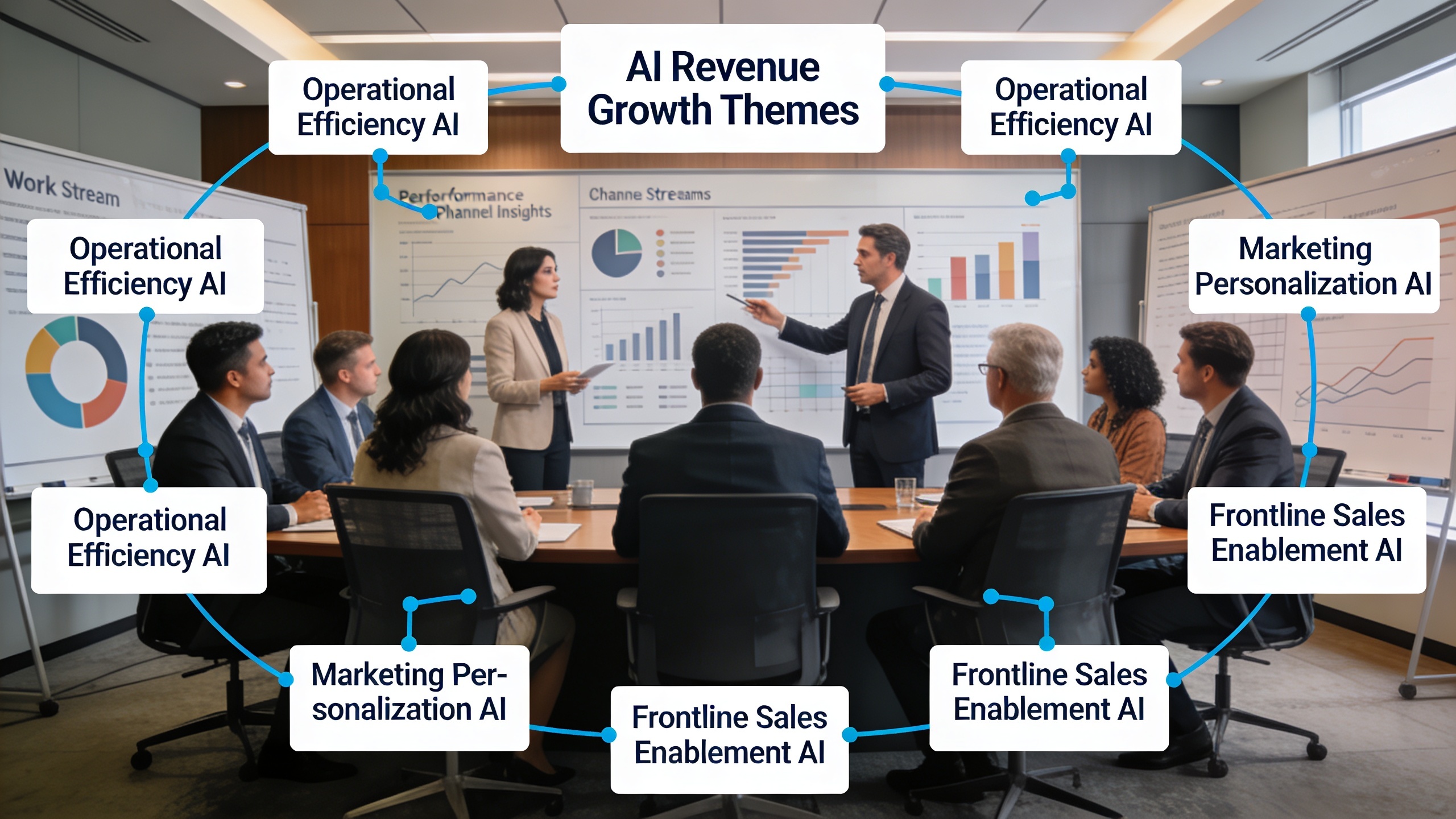
The 10 Hot Topics Shaping Revenue Growth With AI

If leadership is asking where to place bets now, here are the ten hot topics worth tracking. Some sit closer to operations, some to marketing, some to frontline sales. Together, they show where AI is really reshaping revenue generation—not in isolated tricks, but across the full go-to-market system.

  1. Autonomous lead scoring. Models that recalculate priority in real time based on intent, engagement depth, and account changes are replacing static point systems.
  2. AI agents for SDR workflows. Agents can research accounts, summarize news, draft first-touch emails, propose call angles, and tee up follow-up tasks without pretending to be a closer.
  3. Account-based orchestration. Instead of chasing individual leads, teams are using AI to spot account-level momentum across multiple stakeholders and channels.
  4. Intent data fusion. The real edge comes from blending first-party web behavior, third-party research signals, CRM history, and technographics into one view.
  5. Predictive expansion and churn detection. Revenue growth isn't just net-new logo hunting. AI can uncover upsell paths and churn risk inside the existing base, often before account managers spot it.
  6. Revenue-linked content marketing. The old divide between thought leadership and sales enablement is fading. Teams now map assets to buying-stage signals and measure which pieces actually move pipeline.
  7. Search-driven buying intelligence. SEO optimization is no longer only a traffic game. Search behavior, landing-page journeys, and topic clusters can reveal urgency and buying stage when connected to sales systems.
  8. Social selling with signal prioritization. Social media marketing works better when AI flags which accounts are engaging, hiring, funding, or discussing relevant pain in public channels.
  9. Conversational intelligence for coaching. Call transcripts now feed models that identify objections, competitor mentions, talk-to-listen ratios, and deal risk patterns at scale.
  10. Agentic marketing automation. The newest wave isn't just automated nurture. It's systems that adapt campaigns, segment audiences, and trigger outreach based on shifting revenue signals.

The companies that win with these trends won't be the ones chasing every shiny release. They'll be the ones choosing a few high-value use cases, wiring the data correctly, and insisting on measurable commercial outcomes. Gartner has said the advantage is moving to organizations that integrate AI across the revenue cycle, not just inside one step. That feels exactly right. Fragmented intelligence creates fragmented growth.

So what should a leadership team do on Monday morning? Start with one hard question: where does revenue leak today? Bad qualification, slow follow-up, weak personalization, low rep productivity, poor expansion visibility—pick the biggest leak and build there. That's how an AI sales engine stops being a pilot and starts becoming the way the company sells.