The Operating Model, Governance, and Content Strategy Behind Safe AI Upsells
None of this works for long without discipline. GenAI can sound convincing even when it's wrong, and a charming wrong answer still becomes a refund, a chargeback, a compliance issue, or a very public screenshot. That is why serious deployments use retrieval-augmented generation, policy guardrails, approval logic for sensitive offers, and explicit escalation paths. In regulated sectors, the bar is even higher. The EU AI Act is already pushing companies toward transparent disclosures and explainable decisioning, especially when commercial recommendations are involved.
The operating model matters just as much as the model itself. The companies getting paid aren't handing this project to IT alone or to the contact center alone. They put service leaders, data teams, sales ops, legal, product owners, and finance in the same room and force them to agree on one ugly but necessary question: what counts as a good interaction? If service optimizes for speed while sales optimizes for conversion and finance optimizes for margin, the AI will be pulled in three directions and perform badly in all of them.
"What counts as a good interaction?"
Guardrails matter more than scripts
A good rule of thumb is simple: let AI handle low-risk, high-volume tasks automatically; let AI assist humans on medium-risk conversations; require approval or direct human ownership for high-value or high-compliance moments. Keep a hard boundary around pricing exceptions, regulated disclosures, cancellations with legal implications, and any upsell that could be interpreted as manipulative during a vulnerable interaction. Mess this up and the savings vanish. Fast.
The knowledge layer is where many programs quietly win or fail. If your help center articles are outdated, your policy library is fragmented, and your product data is inconsistent, the bot will mirror that confusion at scale. On the flip side, a clean knowledge base turns every solved issue into training fuel for better service, sharper offer logic, and stronger front-line playbooks. Service transcripts become commercial intelligence. They reveal where customers hesitate, which benefits land, and which objections keep resurfacing.
- Start with top contact drivers and top margin opportunities, not with the flashiest demo.
- Define hard no-sell scenarios before launch so the AI knows when resolution must stay pure.
- Measure containment, first-contact resolution, conversion rate, refund avoidance, and margin per contact together.
- Audit prompts, knowledge sources, and offer logic weekly in the early phase. Models drift. Teams forget. Reality changes.
- Give human agents full conversation context on handoff, including what the AI tried, what it offered, and why.
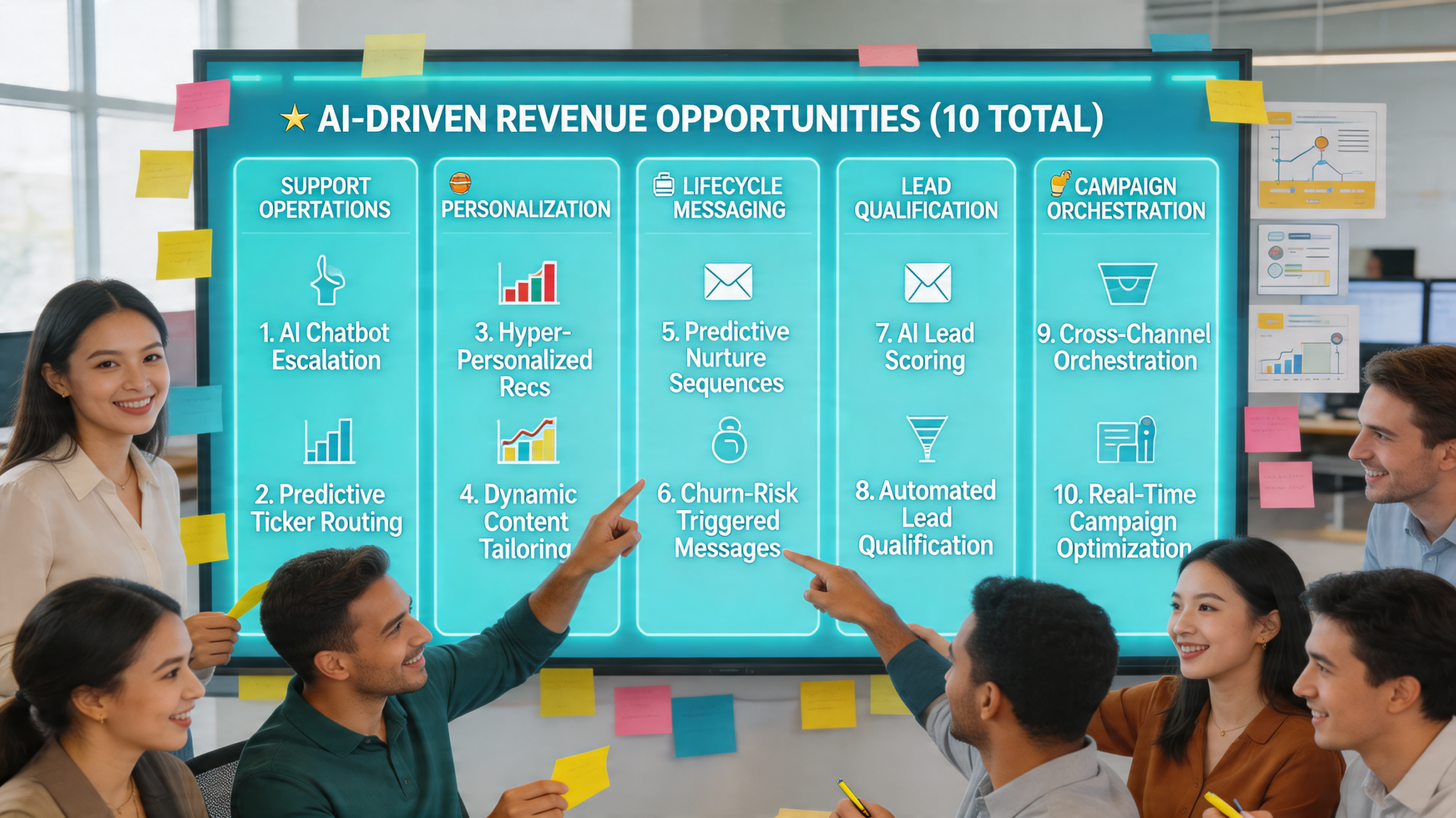
10 Hot AI Revenue Plays, From Service Ops to Marketing Automation
If you're wondering where to start beyond the obvious chatbot pilot, here are ten high-heat areas where businesses can use AI to grow revenue while tightening operations. They stretch from service mechanics to commercial execution, because that's the point now: the wall between customer support and revenue generation is getting thinner by the quarter.
- AI-first triage and routing. Use intent detection to classify requests instantly, solve easy contacts automatically, and push complex issues to the best human queue with full context. This cuts waste before an agent even says hello.
- Agent assist with next-best offer guidance. While the rep works the case, the system scores likely add-ons based on fit, history, and margin, then suggests one offer at the right moment instead of five bad ones.
- Voice AI for renewals, upgrades, and save calls. Multimodal and voice-capable agents are getting better at natural pacing, objection handling, and scheduling follow-up tasks, especially in telecom, travel, utilities, and financial services.
- Return-to-exchange journeys. Retailers are using AI during return flows to recommend substitutes, store credit bonuses, bundles, or size alternatives. Done well, a refund request becomes retained revenue.
- Proactive service triggers tied to churn risk. If the model detects repeated friction, declining usage, or contract-end danger, it can launch a save play before the customer formally leaves.
- Field service upsells. In home services, industrial maintenance, and healthcare scheduling, AI can surface maintenance plans, premium appointments, replacement windows, or financing options during issue resolution.
- Knowledge-driven cross-sell in B2B support. When a customer asks how to do something advanced, that often signals readiness for a higher tier, additional seat licenses, training, or consulting hours. The service desk should not miss that clue.
- Service intelligence feeding blog automation. Support conversations expose the exact phrases customers use, the objections that block purchase, and the use cases people struggle to understand. That material is gold for editorial teams.
- Service data flowing into digital marketing automation and social media marketing. Complaint themes, product confusion, and feature demand should inform audience segmentation, retention campaigns, paid creative, and public-facing response strategy instead of sitting idle in the ticket queue.
- Agentic AI for multi-step commercial workflows. One agent can diagnose the issue, another can check eligibility, a third can draft the offer, and a fourth can prepare the handoff or follow-up task. That's where the newest enterprise programs are heading.
Not all ten deserve investment on day one. Pick one cost lever and one revenue lever, then run a 90-day pilot with a clear baseline. A smart first test might be AI for billing inquiries plus one carefully constrained upgrade offer. Or return automation plus exchange recommendations. Or renewal support plus save prompts. Keep the scope tight enough that you can see cause and effect instead of arguing about anecdotes.
So, can AI customer service increase upsells while cutting cost to serve? Yes. The evidence is already on the table, from Delta to Shopify to HSBC. But the companies that win won't be the ones with the loudest bot launch. They'll be the ones that treat service as a live commercial system, design guardrails before prompts, and understand that every resolved problem is also a chance to deepen the relationship. By 2027, when AI agents are expected to be standard in enterprise sales and service, that won't feel like a bold strategy. It'll feel like table stakes.