Can AI Customer Service Increase Upsells While Cutting Cost to Serve?

Yes—If Support Acts Like a Revenue Engine

BUSINESS INTELLIGENCE QUARTERLY • 2025

Support used to sit on the expense line, quietly chewing through budget while sales got the glory. Inboxes piled up. Phone trees annoyed people. Agents spent half their day hunting for answers they should've had in front of them already. That's changing fast. With generative AI, the service desk can answer routine questions in seconds, spot expansion signals while the customer is still engaged, and hand a polished recommendation to a human rep before the moment goes cold.

So, can AI customer service increase upsells while cutting cost to serve? Yes—but only when the system is built for both outcomes at once. A bot that deflects tickets and irritates loyal customers is cheap in the worst possible way. The winning model resolves the easy stuff automatically, equips agents for nuanced conversations, and treats every interaction as a clue about need, urgency, and readiness to buy more. That's not a support tweak. That's a different revenue model.

"AI customer service can increase upsells while cutting cost to serve, but only when the system is built for both outcomes at once."

Why AI Changes the Math

McKinsey's latest work makes the scale hard to ignore. Generative AI could unlock $2.6 trillion to $4.4 trillion in annual economic value, and customer care sits near the front of the line because it combines huge labor pools with repetitive work and direct commercial influence. In high-potential settings, AI can automate 60-70% of routine interactions. That alone changes the math. Fewer touches, shorter queues, less after-call work, and agents who spend more time on cases that actually warrant a salary.

The cost savings aren't mysterious. AI drafts replies, summarizes conversations, fills CRM fields, searches policy documents, pulls order history, and suggests the next best action while the agent is still speaking. Average handle time drops. Training ramps faster because new reps aren't memorizing every exception from scratch. Quality assurance gets lighter because the system captures transcripts and flags risky responses in real time. Across the market, the pattern taking shape is a 20-40% reduction in cost to serve when companies automate low-complexity contacts and stop making people do machine work.

The Relevance Advantage

But cost reduction is only half the story. The bigger prize is relevance. AI can see usage data, contract history, open tickets, product gaps, shipment urgency, even sentiment drift, then match that context to a higher-value offer. A security customer asking about policy limits may need an enterprise tier. A property client requesting one-off market analysis may be ready for advisory services. The win comes from relevance: AI spots the moment a customer has outgrown the basic plan and frames the next offer as help, not pressure.

That doesn't mean every interaction should end with a sales pitch. Bad timing wrecks trust, and one clumsy hallucination can undo months of loyalty. The strongest programs use a hybrid model: AI handles password resets, status checks, simple billing changes, and first-draft answers; humans step in for exceptions, negotiation, and emotionally charged issues. When AI handles the repetitive work, human agents get the moments that actually move margin. That's where upsells land without feeling grubby.

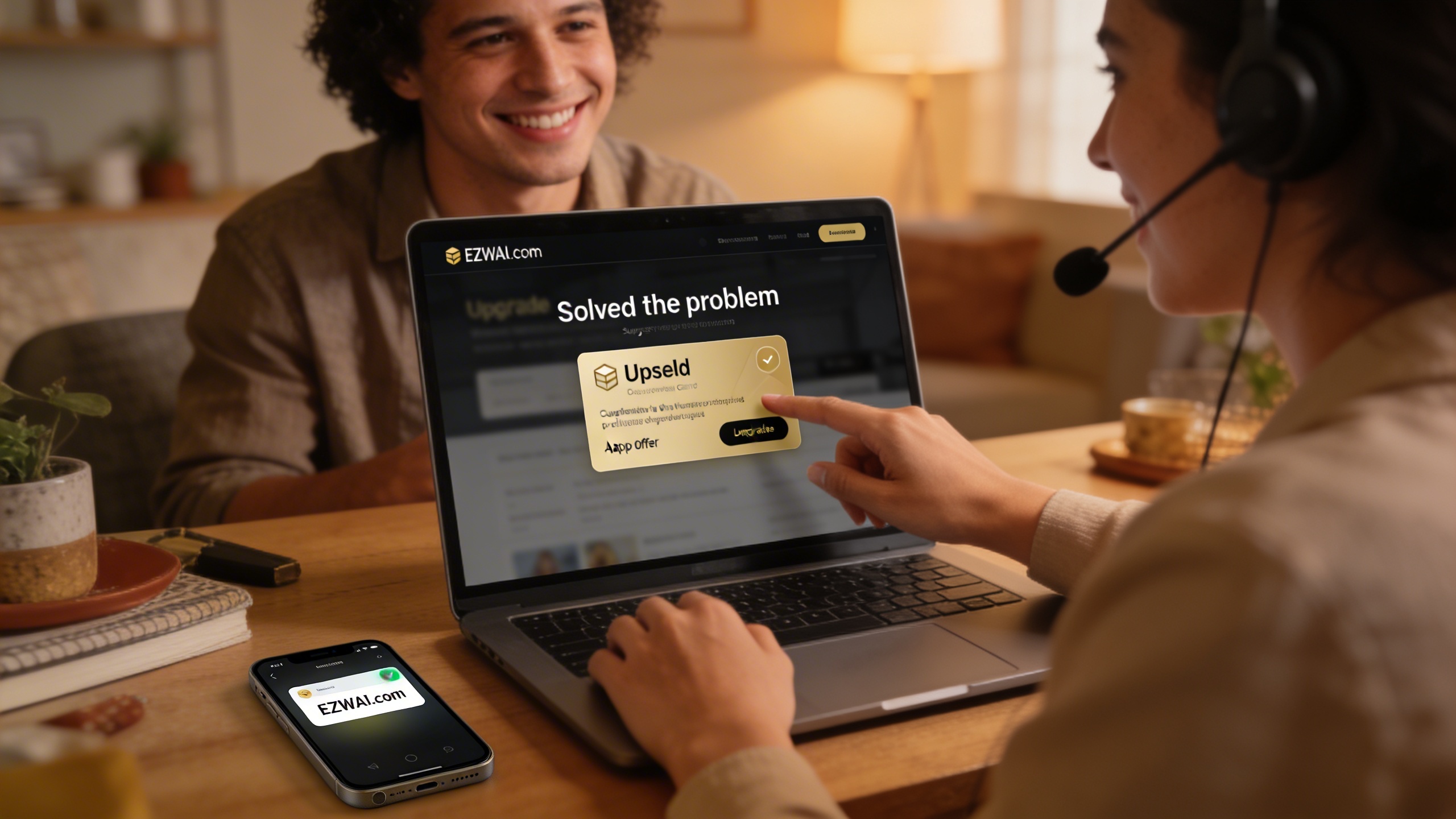
Support rep presenting a timely in-app upsell to a satisfied customer, illustrating marketing automation and social media marketing

Where Upsells Happen

Timing, Trust, and Marketing Automation

Upsells in service work because the customer has already raised a hand. They're telling you what's broken, what's missing, what they're trying to accomplish faster, cheaper, or with less risk. That's priceless. The offer should arrive after progress is made, not before. Solve the problem, confirm the outcome, then surface the next logical step—a higher plan, premium onboarding, managed support, a faster fulfillment option, a usage bundle. Soft touch. Clear value. No script-y nonsense.

"The questions customers ask after purchase are often more valuable than the claims marketers make before purchase."

Recent earnings back that up. Zscaler posted $815.75 million in revenue, up 25.9% year over year, alongside $3.4 billion in annual recurring revenue, also up 25%, as AI-enhanced services helped retention and upgrades. Analysts following Box kept Buy ratings while pointing to AI upsell and net retention improvement as real drivers, not slide-deck theater. And Cushman & Wakefield rolled out an AI advisory tool that analysts described as a game-changer for fee growth and upsell services. Different sectors, same pattern: lower-friction service opens the door to larger deals.

There's another layer most operators miss. Service data shouldn't stay trapped in the contact center. The questions customers ask after purchase are often more valuable than the claims marketers make before purchase. Fed into content marketing and digital marketing automation, those questions sharpen onboarding flows, upgrade campaigns, help-center sequences, renewal nudges, and suppression rules for poor-fit prospects. They also expose gaps between promise and reality—which, frankly, is where margin leaks start.

Picture Joe's Site selling tiered retainers or software-enabled services. If AI sees repeated support conversations about custom reporting, faster turnarounds, or integration headaches, it can trigger a precise expansion path instead of dumping the account into a generic nurture stream. The same signals can tell sales which accounts are ripening, tell finance which service motions are too expensive, and tell service leaders which promises need clearer language. That's real cross-functional lift. Not flashy. Effective.

Building the System

Agents, Data, and Content Strategy

To get there, the plumbing has to be right. An AI assistant can't make smart offers if it only sees a chat transcript. It needs access to the knowledge base, product catalog, contract terms, order status, CRM history, usage telemetry, service policies, and permission rules—ideally in a governed layer that keeps sensitive fields masked unless they're required. Retrieval-augmented generation helps here. So does ruthless taxonomy work. If your data labels are a mess, the model will sound confident and still be wrong.

Agentic automation is the hot phrase right now, and some of it deserves the hype. A well-scoped AI agent can verify identity, open or close tickets, update billing details, schedule field service, recommend an add-on, and summarize the whole exchange for the record. But scope matters. Start with narrow tasks, build approval gates, and design clean handoffs to humans. The point isn't autonomy for its own sake. It's dependable throughput. And a faster path from issue to offer.

Content Strategy from Service Data

The smartest teams turn service transcripts into a living content strategy. If customers keep asking the same pre-upgrade question, that language belongs in product pages, renewal emails, pitch decks, and sales talk tracks. At EZWAI.com, the sharper move would be to mine those conversations for SEO optimization opportunities, clearer FAQs, and tighter commercial messaging—not just prettier dashboards. Service can even guide what not to publish. If the data shows a topic creates confusion or attracts poor-fit buyers, stop feeding it.

Guardrails matter because service is where privacy, brand voice, and liability collide. PII should be masked by default. High-risk intents—refund disputes, regulated advice, contract changes, security incidents—need escalation rules, audit trails, and human approval paths. Teams also need a red-team process for prompt injection, hallucinated policies, stale source content, and tone failures. The old customer-service standard still applies: first-contact resolution, clear accountability, and fast recovery when something goes sideways. AI doesn't excuse sloppiness. It exposes it.

What Leaders Should Measure in the Next 90 Days

So what should a leadership team measure over the next 90 days? Not vanity numbers. Not raw chatbot volume. Track the revenue story and the cost story together, because one without the other invites self-deception. A bot can deflect a ticket and still create rework, churn risk, or missed expansion. You want proof that service got cheaper, faster, and more commercially useful at the same time.

Five Numbers That Matter

  1. Cost per resolved contact by intent, not just blended across the whole queue.
  2. Containment rate paired with reopen rate, because fake resolution is expensive.
  3. Upsell or add-on acceptance after AI-assisted interactions, segmented by offer type.
  4. CSAT and first-contact resolution for AI-assisted cases versus human-only cases.
  5. Expansion revenue, churn, and time-to-resolution by customer segment so the margin picture stays honest.

Pilot narrowly. Pick three common intents, one upsell motion, and one segment with enough volume to matter. Give agents AI assist before you push full self-service, then compare outcomes against a control group: handle time, reopen rate, attach rate, resolution quality, and customer satisfaction. If the model saves minutes but drags CSAT, you haven't found efficiency. You've just moved cost into churn and called it progress.

Most failures look similar. Companies chase deflection, serve irrelevant offers, and discover that customers aren't irritated by AI—they're irritated by useless AI. Or they let the model improvise against stale documentation and call it automation. Or the service team owns the tool but not the commercial target, so upsell signals die in someone else's queue. Fix the incentives, clean the knowledge, and design the journey end to end. That's the real work.

Here's the blunt answer. AI customer service can absolutely increase upsells while cutting cost to serve, and the gap between leaders and laggards is going to widen quickly. The winners will treat support as a revenue-bearing operating system, not a digital suggestion box. If Joe's Site—or any business with recurring customers—gets that right, service stops being a cost center people tolerate. It becomes a profit center people build around.