Can AI Customer Service Increase Upsells While Cutting Cost to Serve?

How Generative AI is Transforming Support from Cost Center to Revenue Engine

MAY 2026 EDITION

The Economics Are Hard to Ignore

For years, customer service sat in the budget like a necessary headache: expensive, understaffed, and rarely treated as a serious growth engine. That posture is getting old fast. Generative AI is pushing support out of the cost-center basement and into revenue territory, where every conversation can solve a problem, deepen loyalty, and, yes, open the door to a bigger sale.

The short answer is yes: AI customer service can absolutely increase upsells while cutting cost to serve. McKinsey's work on generative AI pointed to customer operations as one of the richest pools of economic value, and the market has moved in that direction with startling speed. The businesses winning here aren't just dropping a chatbot onto a help page and calling it transformation. They're redesigning the whole service motion so AI handles routine work, humans tackle complexity, and the handoff between service, sales, and retention feels simple instead of clumsy.

"AI customer service can solve a problem, deepen loyalty, and open the door to a bigger sale—all in the same conversation."

What the Numbers Say

The economics are hard to ignore. Gartner's recent outlook puts average cost-to-serve reductions around 30%, with many organizations pulling interaction costs down from the $6 to $12 range to under $4. In benchmark data cited across 2025 and 2026, AI-enabled teams have pushed that figure even lower. One before-and-after view shows cost per interaction falling from $8.50 to $4.20. That's not a small efficiency play. That's a structural reset.

Upsell performance is moving at the same time, which is why executives have stopped treating service AI as a mere labor story. Forrester reported average cross-sell revenue lifts of 28% among adopters, while McKinsey and other firms have shown AI-driven personalization boosting upsell rates by 20% to 35%. Think about what that means in practice: the same service conversation that once ended with a refund, a password reset, or a shipping update now has enough context to recommend a premium tier, a warranty, a faster plan, or a bundled add-on without sounding like a telemarketer.

And the adoption curve has bent sharply upward. IDC says 65% of enterprises now use generative AI in customer service, and Tier 1 tickets are increasingly AI-handled. Bain's 2026 analysis put average returns at $3.50 for every $1 invested, with payback periods under six months. Fast payback matters because boards are tired of vague AI theater. They want margin expansion. They want measurable revenue lift. This is one of the few AI use cases already delivering both.
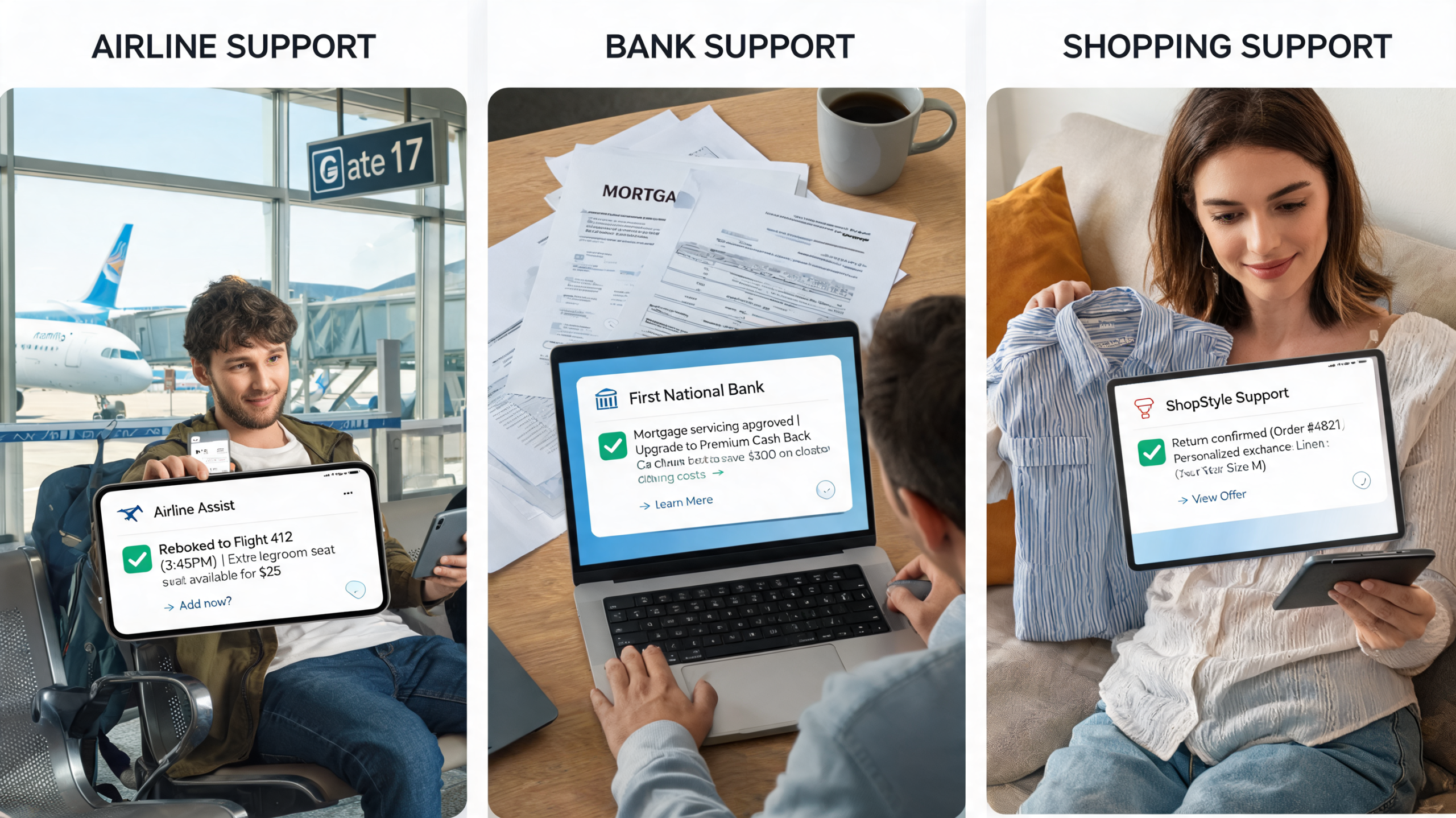
AI-assisted service interactions offering relevant upgrades during support moments, showing digital marketing automation in a natural customer experience

Where Upsells Actually Come From

Why the math works

Labor is part of the story, but it isn't the whole thing. AI cuts cost because it absorbs repetitive demand, shortens handle times, drafts responses, summarizes interactions, and routes issues more intelligently. It increases upsells because it can read the full customer picture in real time: order history, product usage, churn risk, browsing behavior, service intent, sentiment, even billing friction. Humans can do some of that. They just can't do it at scale, every time, in two seconds.

  • Routine contacts get automated, which lowers staffing pressure and reduces queue volume.
  • Agents receive live prompts for the next best action, so they sell with context instead of improvisation.
  • Personalized offers land inside service moments, when customer attention is already high.
  • Supervisors get cleaner analytics, which tightens scripts, escalation rules, and training loops.

The most effective AI upsells don't feel like upsells. That's the trick. A customer asks about a delayed flight and gets offered extra legroom on the rebooked segment. Someone contacting a bank about mortgage servicing is shown a card upgrade with relevant rewards. A shopper processing a return gets a better-fit replacement, plus accessories at a discount. The offer is tied to the problem in front of them, not sprayed in from some disconnected campaign calendar.

JetBlue's AI Success Story

Using generative AI through Google Cloud, JetBlue automated a large share of support volume and paired service interactions with personalized upgrade and bundle offers. The result: a 35% drop in cost to serve and a 27% rise in upsell conversion—even during high-stress moments like delays and rebookings.

That shift depends on better signal detection. AI is good at catching intent humans miss: repeated mentions of frequent travel, frustration with plan limits, concern about product longevity, hints that a household is growing, clues that a customer is ready for premium support. Forrester's Dipanjan Chatterjee described this as the service-to-sales transition, and that phrase nails it. The service event becomes a commercial moment because the system recognizes need before the agent has to guess.

"The service event becomes a commercial moment because AI recognizes need before the agent has to guess."

Ten hot AI opportunities businesses can use right now

If you're looking beyond the contact center, here are ten of the hottest implementation areas where AI can grow revenue while tightening operations:

  1. AI agents for Tier 1 support and order status.
  2. Real-time next-best-offer prompts during chats and calls.
  3. Churn prediction tied to save offers and loyalty perks.
  4. Billing and collections outreach that adapts tone by risk segment.
  5. Multilingual service at scale for global expansion.
  6. Automated knowledge base generation and blog automation from recurring customer questions.
  7. Voice analytics that spot upsell cues and compliance risk in the same pass.
  8. Product recommendation engines embedded in returns, onboarding, and troubleshooting flows.
  9. Self-service portals that personalize help articles, plan upgrades, and renewal options.
  10. Cross-functional insight loops that feed content strategy, merchandising, pricing, and field operations.
Cross-functional team designing customer-friendly AI workflows and guardrails, highlighting content strategy and marketing automation in a modern office

What Real Companies Are Doing

HSBC's rollout points to the same pattern in a more regulated environment. The bank used AI agents on top of its service infrastructure to flag likely upgrade opportunities inside ordinary customer conversations. Mortgage servicing discussions became opportunities for related credit products. The reported outcome: roughly $150 million in annual revenue lift and lower reliance on frontline staffing growth, while customer satisfaction stayed strong. That's the part many skeptics miss. Done well, AI doesn't have to trade service quality for efficiency.

Across Zendesk deployments, the aggregate story is similar. Hundreds of enterprises using AI copilots reported lower cost to serve and measurable improvements in cross-sell or accessory attachment. Retail returns are a perfect case. A return isn't usually a happy interaction, but AI can use that moment to suggest a replacement item, a better size, or a complementary product. That recovers revenue that would otherwise disappear.

The hybrid model is winning

The strongest operators aren't replacing everyone. They're building AI-first, human-escalate service. AI resolves simple contacts, drafts responses, summarizes account history, and recommends offers. Human agents step in for edge cases, emotional situations, negotiation, or high-value sales. That hybrid approach is why agent productivity has jumped so sharply, in some studies from 20 to 30 tickets per day up to 60 or 80 in AI-assisted environments.

  • AI handles speed, consistency, and pattern recognition.
  • Humans handle judgment, empathy, and exceptions.
  • Together, they close more value per conversation than either could alone.

How to Make It Work Without Annoying Customers

Plenty of AI service rollouts still fail. Usually for boring reasons. Bad data. Weak guardrails. Offers that don't match the customer's need. Or leadership gets hypnotized by the bot itself and ignores the workflow around it. The real design question isn't Can the model talk? It's Can the business orchestrate resolution, recommendation, escalation, and measurement in one coherent motion?

Start with intent classes that already drive repeat volume: order tracking, billing questions, returns, plan changes, appointment scheduling, claims status. Then map the adjacent revenue action for each one. A customer asking about product setup may need premium onboarding. A subscriber nearing usage limits may need an upgraded tier. Someone repeatedly contacting support about quality issues may need a replacement bundle or a save offer before they churn. That's operational design, not magic.

"AI customer service works best when it stops pretending service and sales are separate universes."

And here's the final point: AI customer service works best when it stops pretending service and sales are separate universes. They aren't. The customer doesn't care which department owns the interaction. They care whether the answer is fast, accurate, and genuinely helpful. If the same conversation also surfaces the right upgrade at the right moment, you've done more than cut costs. You've built a smarter commercial system.