Benchmarking AI automation platforms

Agents, orchestration, and ROI for 2025 buyers

WINTER 2025

The question haunting every 2025 buyer isn't whether AI will help. It's which platform delivers value fast enough to matter and accurate enough to trust. Benchmarks turned into boardroom slides last year; this year, they're purchase orders. And the most telling yardstick right now—DRACO—puts real-world, cross-domain research under a microscope and doesn't flinch.

Fast is nice; right is money. Agents that rush through tasks feel impressive on a demo. Then an analyst spends a day mopping up hallucinations, and the savings evaporate. DRACO's framing—deep research across finance, shopping, tech, and academia—mirrors the messy, multi-step work that chews up budgets in the wild.

"Benchmarks should lower your risk, not your standards."

This guide cuts through vanity metrics and marketing fog. We'll translate DRACO's results into buying criteria, show where agents and orchestration stack up (and fall apart), and share field notes from teams turning benchmarks into steady ROI. Keep your pen handy. You'll want a checklist by the end.

Why benchmarks matter in 2025

Agent platforms promise autonomous execution—gather sources, reason across them, produce defensible outputs—while orchestration glues the workflow together across tools, models, and data. That glue is where dollars are made or lost. When orchestration is brittle, edge cases pile up and people quietly step back in. When it's clean, every new use case rides the same rails, and the cost line bends down.

The benchmark shift in 2025—from synthetic puzzles to grounded deep research—hits the heart of enterprise work. You're not measuring party tricks anymore; you're scoring how well a system sustains context, cites with discipline, and resists bias across domains. Benchmarks should lower your risk, not your standards. And they should line up with the work your org does every week.

The Real Cost of Poor Orchestration

Costs hide in odd places. Input token footprints balloon on rigorous tasks; DRACO shows leaders absorbing hundreds of thousands of tokens per run and still coming out ahead on accuracy. That's the trade: pay more to read more, get better answers, reduce rework.

If an agent hits 20–30% higher task completion on report-grade jobs, you're swapping analyst-hours for compute with predictable upside.

Where orchestration breaks

Context handling across steps is the first crack. Agents retrieve ten sources, summarize, then lose the thread when reconciling conflicts. Logging and traceability are the second crack—without a clean audit trail, QA becomes folklore. The third is permissions: data access gets flaky across systems, and the workflow sputters when a connector rate-limits at the worst time.

And latency isn't a footnote. If your agent takes half an hour to crawl and synthesize, a sales desk can't ride it mid-call. Nightly batches love accuracy; front-line teams crave responsiveness. You'll need both modes—one tuned for precision, one for speed—routed by orchestration that knows when to switch.

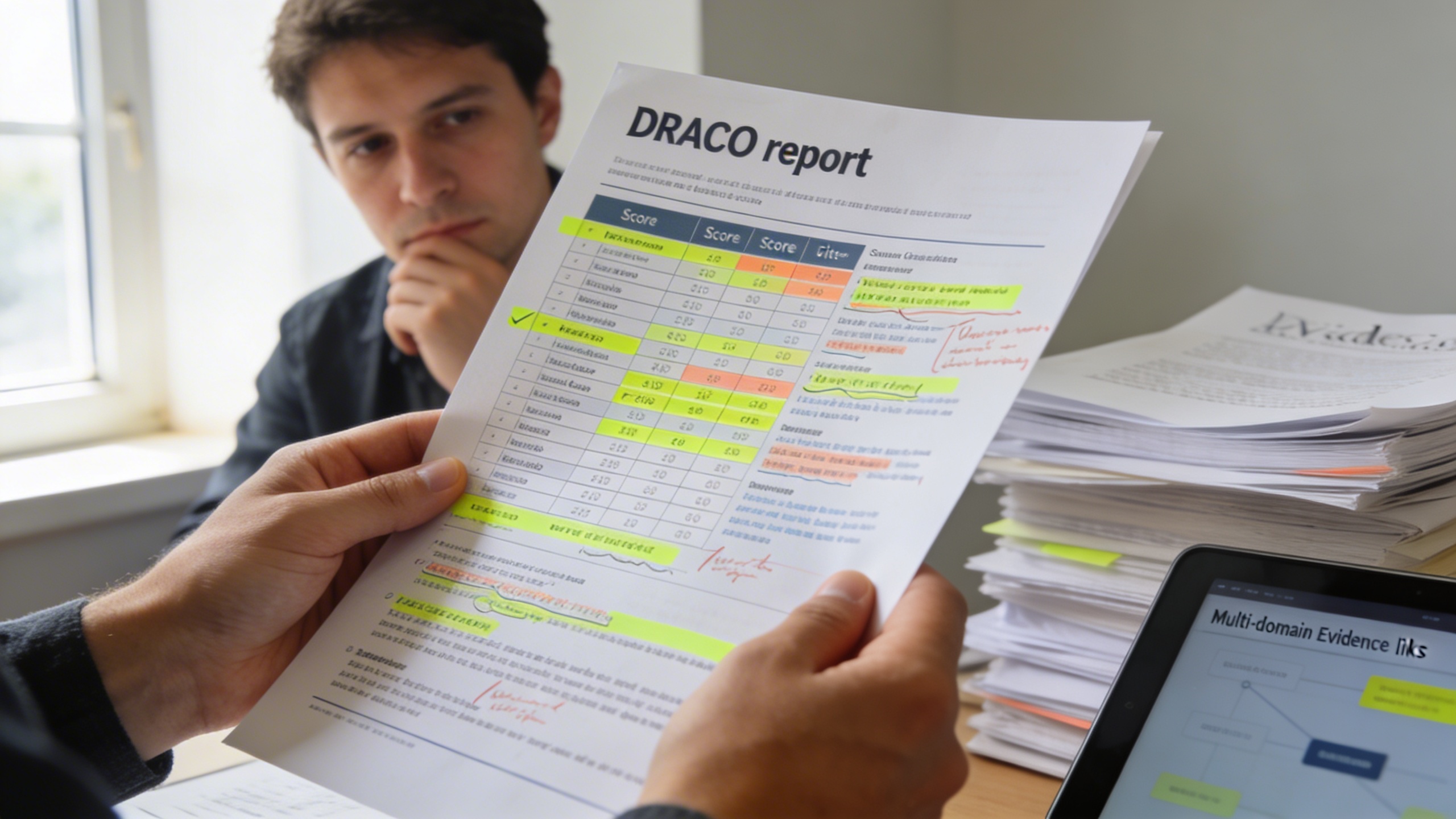
Research analyst studying a DRACO benchmark report with highlighted scores and sources, reflecting SEO optimization and content strategy priorities

Reading DRACO like a buyer

DRACO grades "complex deep research tasks spanning 10 domains," and its authors call out what it actually values: accuracy, completeness, and objectivity across end-to-end work. That lens punishes hand-wavy output and rewards careful sourcing and cross-domain reasoning. It's not a parlor game; it's enterprise reality distilled.

Here's the scoreboard that shook up 2025: Perplexity Deep Research leads at 70.5% (Opus 4.6), with Opus 4.5 at 67.2%. Gemini's deep-research preview lands around 59.0%, while OpenAI's o3 deep-research build trails at 52.1%. The biggest gaps show up where buyers actually make money—finance (+21.6 points), shopping/product comparison (+10.9), technology (+9.8), and academic research (+9.3).

"Speed is a tactic, accuracy is a strategy."

There's a cost for that lead: Perplexity gulps a hefty average of 778,711 input tokens, yet still posts superior accuracy. OpenAI o3, by contrast, shows the slowest stride at 1,808.1 seconds and mid-tier output around 24,944 tokens.

Translate that into ROI. On workflows like expert reports and market comparisons, a 20–30% lift in task completion rate means fewer escalations, fewer rewrites, and a shorter path to publication-grade deliverables. The org feels it first in analyst bandwidth, then in cycle time to decisions. You're buying accuracy to buy back time.

A mini scorecard you can steal

  • Accuracy and completeness: weighted 40%. Judge against domain truth, not vibes.
  • Objectivity and citation quality: 25%. If you can't trace it, you can't ship it.
  • Token efficiency: 15%. Pay compute where it saves headcount, not everywhere.
  • Latency: 10%. Batches forgive; live teams don't. Segment by use case.
  • Cross-domain stability: 10%. Finance today, tech tomorrow—same rails or bust.

One more note buyers keep repeating: orchestration beats one-off cleverness. A "super" agent that dazzles solo but can't hand off to retrieval, enrichment, and verification at scale gets lonely in production. Joe's Site has seen teams ship faster when they standardize traces, prompts, and QA gates across every agent—even when models differ under the hood.

Real Buyer Results

Benchmarks aren't trophies. They're traffic signs. In DRACO-style tasks, you can feel the delta when the leader's stack takes the wheel. Picture a research pod generating a quarterly tech landscape: the winning agent weaves vendor filings, academic sources, and product docs into a defensible narrative without collapsing under contradictions. The team edits, not excavates.

A retailer piloting automated competitive audits leaned into agent chains tuned for product comparison—the same domain where the DRACO lead hits double digits. Weekly roll-ups stabilized; buyers walked into meetings with crisp rankings and verifiable links. The kicker: fewer follow-up requests from executives because the sourcing held up in the room.

Technology Analysis Success

In technology analysis, the gap grew just when it mattered—launch season. Teams needed side-by-side capability matrices, pricing nuances, and licensing footnotes without hallucinated features. The outperforming stack handled multi-step reconciliation and flagged ambiguities for human review instead of glossing over them.

What failed (and how teams pivoted)

  • Underspecified guardrails: Agents over-summarized and lost caveats. Fix: add verification passes and citation policies at the orchestration layer.
  • Token penny-pinching: Early cutoffs chopped context. Fix: spend on input where rework costs more; cap outputs with post-processing.
  • Latency blind spots: Live teams hit timeouts. Fix: split workloads—batch deep research overnight; serve quick triage with lighter agents during the day.

The throughline: platforms that log, trace, and explain their steps survive audits and scale faster. The ones that can't show their work stall at the pilot gate.

From marketing automation to SEO optimization: operational playbooks

Now the fun part—turning benchmark advantage into revenue operations. When the research layer gets trustworthy, pipelines unlock across go-to-market. Think campaign blueprints that inherit factual backbones, sales decks refreshed weekly with verified intel, customer service macros sourced from the same repository. Your org stops copy-pasting. It starts orchestrating.

"Your org stops copy-pasting. It starts orchestrating."

Go-to-market workflows that compound

  • Campaign research engine: Spin up agents to map competitors, audiences, and channels. Feed creative briefs with citations that don't crumble. It lifts content strategy quality and shortens review cycles.
  • Offer and pricing intelligence: Weekly deep scans of market moves synthesize into guidance for enablement. Sales stops guessing; messaging stays aligned.
  • Thought leadership at pace: Research-grade drafts become executive posts and webinars without midnight fact checks. That lifts content marketing throughput without torpedoing trust.
  • Social listening with teeth: Orchestrate retrieval from communities and docs, not just surface-level chatter. That supports social media marketing with substance, not hot takes.

As these workflows stabilize, teams see a second-order effect: fewer meetings to "sync on sources," because the system encodes them. The bench becomes a backbone.

Governance and procurement essentials

Under the hood, every winning deployment shares three bones: clean data access, auditable runs, and measurable gates. Data must flow with explicit permissions and masking where needed. Every agent step should be traceable—prompts, retrieved passages, tool calls, final citations. And quality bars must feel like product requirements, not wish lists.

Security and compliance can ride alongside speed when the platform supports policy as code. If your auditors can replay a run and reproduce the result, your leadership can sign off without heartburn. Procurement wants that comfort. Legal demands it. Your roadmap depends on it.

Selection checklist (print this)

  1. DRACO-class performance: Ask for domain breakdowns—finance, tech, shopping, academia—with examples you can verify.
  2. Orchestration primitives: Branching, retries, verification passes, and human-in-the-loop built in. No duct tape.
  3. Tracing and auditability: Full run logs, diff views, and exportable evidence. If it's a black box, it's a risk box.
  4. Token and latency controls: Adjustable depth by use case. Batch mode for accuracy; real-time mode for speed.
  5. Vendor roadmap: Demonstrated improvements across model versions (e.g., Opus 4.5 to 4.6). Ship, don't promise.
  6. Org fit: Connectors to your stack, SLAs that match your load, and pricing that scales with usage—not surprise bills.

One last move: appoint an internal "benchmark czar." Their job is to mirror DRACO-like tasks from your own backlog—quarterly finance summaries, product matrices, academic digests—then publish scorecards. Joe's Site often nudges clients to treat this as a product function, not a project. That mindset change keeps results honest and improvements continuous.