Operations: Speed, Cost, and the New Math of AI automation
If you're a CMO or COO, this is where the case closes. Teams adopting agent-led video workflows report roughly 50% less cycle time on standard campaigns. That means twice the testing, twice the learning, and faster path to the winners you'll scale with media.
Let's talk cost. A year ago, a 60-second social sizzle might run $1,200 in internal time (not counting talent or media). With AI employees handling the rough cut, subtitling, and language variants, you're closer to $600—and you walk away with a dozen ready-to-ship versions instead of one. Value isn't just cheaper; it's more surface area to find signal.
Staffing rebalances too. You don't shrink the creative braintrust; you give them exoskeletons. Editors become conductors. Strategists leave spreadsheets for storyboards. Analysts wire performance back into prompts. Compliance stops playing catch-up because agents keep an audit trail. Nobody misses the midnight caption fix.
Governance without killing the magic
Speed is seductive. Guardrails keep your logo out of the ditch. Set them once, automate the checks, and escalate the weird stuff to humans.
- Maintain a model inventory: who's allowed to use what, for which tasks.
- Consent and rights ledger for footage, music, and voices—synthetic or real.
- Watermark generative portions where policy requires and keep raw originals on file.
- Brand safety prompts and banned terms packed into every agent workflow.
- Route claims and comparative ads through a human legal checkpoint automatically.
Do this well and you don't slow down. You just stop paying tuition to the school of expensive mistakes. AI agents move fast; your system makes sure they don't break things that matter.
Real-World Case Studies
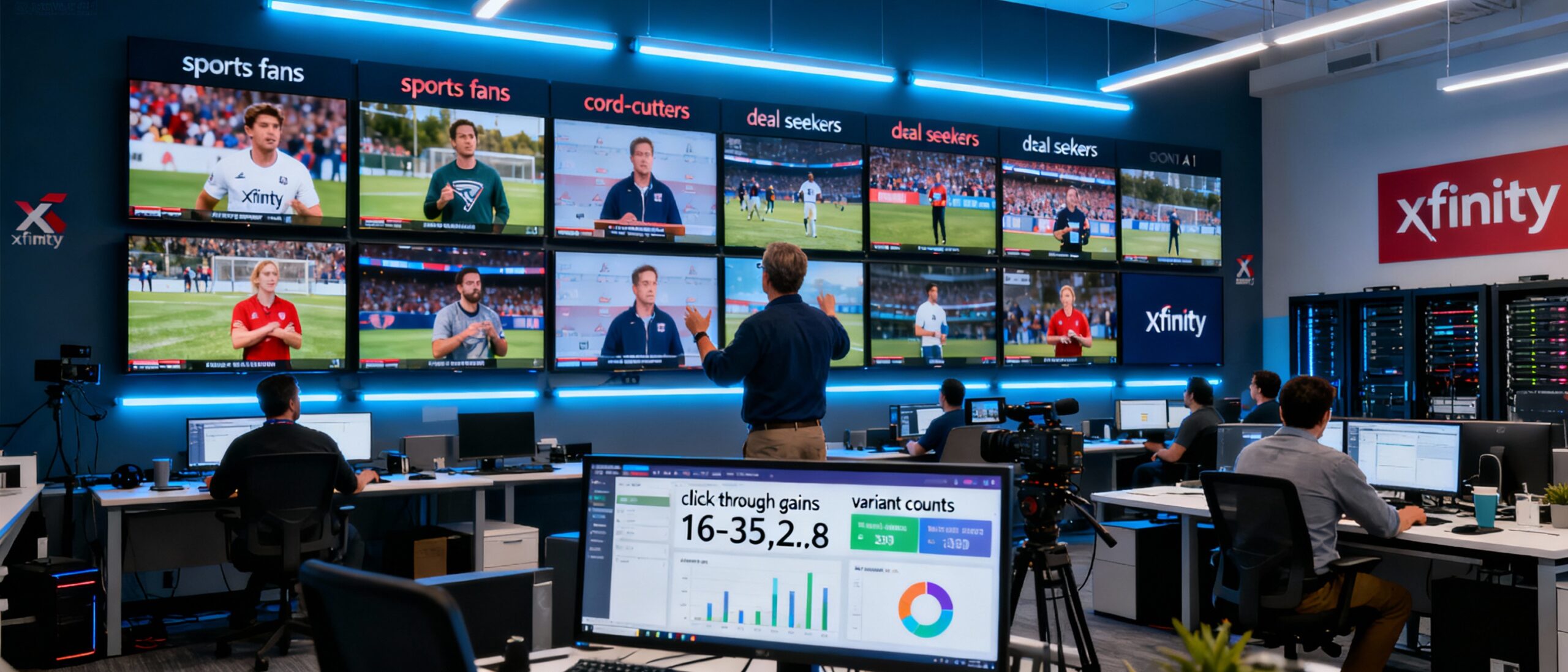
Comcast's Xfinity brand ran an AI-driven personalization program that generated thousands of video variants tied to viewer interests and demographics—sports fans got one cut, cord-cutters another, deal seekers a third. Result: a click-through rate more than 40% higher than static creative, with production running in weeks, not months. That's the promise of personalized video, realized at national scale.
"Cost per click fell 28% over six weeks; foot traffic data showed a visible bump"
We're seeing similar curves in mid-market campaigns. A regional retail chain took one studio day and turned it into 140 hyper-local clips—store name, local landmarks, offer windows—then let the system test five hooks per region. Cost per click fell 28% over six weeks; foot traffic data showed a visible bump in markets where they leaned into personalization.
What success looks like in 90 days
You don't need a moonshot to get moving. A tight 90-day sprint proves the math and builds the muscle. Here's a blueprint agencies and in-house teams are running right now.
- Week 1–2: Stand up your agent stack and guardrails. Load brand rules, product facts, and past winners.
- Week 3–4: Produce one anchor video and 30–50 personalized variants mapped to audience segments.
- Week 5–6: Ship in two markets or channels. Let performance loop back into prompts daily.
- Week 7–8: Kill the losers, spin up second-gen variants from winning hooks, expand languages.
- Week 9–12: Scale winners, lock a playbook, and set quarterly goals tied to pipeline and revenue.
The goal isn't perfection; it's velocity with taste. Set the floor high, then iterate like a maniac. The brands that win treat every cut as a hypothesis and every metric as a lesson.
Bottom line: video has become a system, not a sequence. AI Agents, AI automation, and well-briefed AI employees let you move from "big bet, slow learn" to "many bets, fast learn." If you want a partner that ships real outcomes and not just decks, Contact Us to discuss how these pipelines can transform your video marketing at the speed your market now demands. You can also visit our HOME page to explore more about our comprehensive AI solutions.